Kitchen & Bath · Comparison
Shelf Liner vs Contact Paper
One protects a surface and lifts out. The other resurfaces it and may take the finish with it. The labels barely distinguish them.
By Scooter M. · Published · How we pick

Disclosure · We earn a commission on purchases made through the Amazon links on this page, at no extra cost to you. These picks come from published specifications, not from hands-on use. How this site is funded.
The short answer
Contact paper is self-adhesive vinyl that sticks to the shelf and resurfaces it. Shelf liner, in the sense most renters want, is a non-adhesive grip mat that holds itself and the jars on it by friction alone. In a rental the grip liner is usually the right answer, because it cannot take a cheap shelf's surface film with it. Where you genuinely want to change how a surface looks, contact paper is the only one of the two that does it -- and the word to look for on the label is removable.
These sit on the same shelf in the same aisle in near-identical packaging, and the distinction that matters to a renter is not on the front of either pack. It is a deposit question rather than a decorating one, and it is worth five minutes before you line eight cabinets.
The actual difference
| Non-adhesive grip liner | Removable contact paper | Removable adhesive laminate | |
|---|---|---|---|
| How it stays put | Grip top and bottom, friction only | Water-based adhesive backing | Self-adhesive laminate |
| Published removal claim | No adhesive at all | Removable and repositionable; removes without residue | Removable from a variety of surfaces |
| Roll sizes published | 12 in x 20 ft (also 12x10, 20x24, 20x6) | 18 in x 9 ft and 18 in x 16 ft | 20 in x 15 ft |
| Resurfaces the shelf? | No -- it covers | Yes | Yes |
| Washable? | Machine washable, cold | Wipe clean | Wipe clean |
The risk that makes this a rental question
Rental cabinet interiors are usually melamine or a printed foil over particleboard. That finish is a thin film bonded to the board, and it is not always bonded well -- particularly on a cabinet that is fifteen years old and has been damp under a sink.
Adhesive laminate applied over it can end up gripping that film more strongly than the film grips the board. When you lift the liner at move-out, the finish comes with it in patches. A cabinet interior with its surface peeled is not a wipe-down, it is a replacement shelf, and it is the one outcome in this whole category that actually costs money.
Grip liner cannot do that, because there is nothing bonded to anything. That single fact is why it wins by default in a rental, and it is the same reasoning that runs through best adhesive shelf liners.
"Removable" is doing a lot of work on those labels
Both adhesive products here publish the word. They do not publish the same claim behind it, and the difference is worth knowing.
One publishes removable and repositionable, removes without leaving residue, on a water-based adhesive. Repositionable is the genuinely useful half: adhesive laminate goes on crooked more or less always -- you line up the leading edge, peel the backing, and eight inches in the whole sheet has drifted a quarter inch. If it lifts and realigns, a bad start is recoverable. If it does not, you have used a piece of a roll.
The other publishes removable from a variety of surfaces. That is a weaker claim and a vaguer one -- "a variety" is not a list, and the surfaces it excludes are not named. It is not a bad product; it simply tells you less.
Width decides more than pattern does
This is the specification people ignore and then regret. Match the roll width to the shelf depth and you lay one strip with no seam. Get it wrong and you are butting two pieces together down the middle of the shelf -- which is exactly where everything gets put down, and exactly where the edge lifts first.
Standard wall cabinets and drawers are usually around 11 to 12 inches deep, which the 12 inch rolls cover. Mid-depth shelves and drawer bottoms suit 18 inches. Base cabinets and pantry shelves are often 20 inches or more. Measure front to back before you choose the pattern you liked.
Note the trade buried in that: the product publishing the strongest removal claim comes on 18 inch rolls, and the one covering a base-cabinet shelf in a single piece comes on 20 inch rolls with the weaker claim. There is no single product here that gives you both.
Which one, by where it is going
Cabinet shelves you have to hand back
Grip liner. No adhesive on the landlord's surface, and cabinet interiors are where the fragile finishes live. It also washes rather than peels when something leaks.
Drawers
Either, and grip liner has a second advantage here: it stops cutlery trays and containers sliding every time the drawer opens, which adhesive laminate does not.
Under the sink
Something you can lift out and check under. That cabinet floor is the one surface in a kitchen that regularly gets wet, and a liner laid over a slow leak hides the leak while it does its damage. Sort the plumbing clearance first -- under-sink clearance has the measuring method -- then line it with something removable.
A shelf that genuinely looks bad
Contact paper, after the corner test. This is the one job grip liner cannot do: it covers a scratched shelf, it does not resurface one.
Laying contact paper without bubbles
Both adhesive products publish a printed measuring grid on the backing paper, which is the feature that matters most and the one nobody mentions -- it lets you cut square without a set square.
Then peel back only the first two inches of backing, line that leading edge up against the back of the shelf, and press it down. Work forward in short pulls, smoothing outward from the center with the flat of your hand. Peeling the whole backing off first is the single most common mistake, and on the liner that is not repositionable it is unrecoverable.
The verdict
For most renters, most of the time: non-adhesive grip liner. It protects the shelf, holds the contents still, washes when something spills, and leaves absolutely nothing behind.
Where you want the surface to look different: removable contact paper, chosen for the repositionable claim if the shelf is narrow enough for an 18 inch roll, and only after a corner test has come back clean.
What goes on top of the liner is a separate question, and the fit-first approach to it is in renter-friendly kitchen cabinet organization. Line first, organize second -- it is far harder to line around a rack than to put a rack on a lined shelf.
What to buy for this
Picked from the same registry as our roundups, on published specification. Nothing here has been tested by us, and we say so on every page.
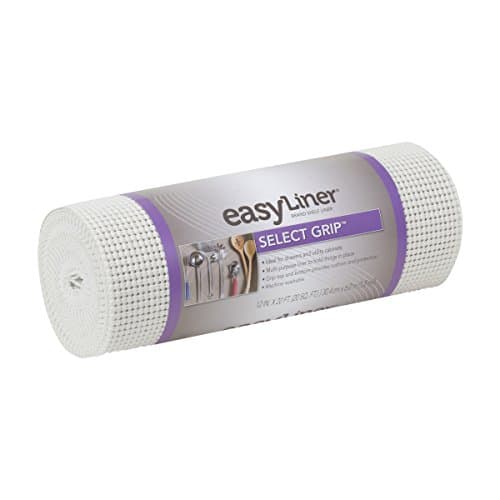
Duck Select Grip EasyLiner (non-adhesive)
Duck · Best for a landlord's shelves you have to hand back
9.0
out of 10
The non-adhesive one, and in a rental it is usually the right answer: it grips without sticking, and it washes rather than peels.
| Specification | Published figure | Source |
|---|---|---|
| Roll size | 12 in x 20 ft; also 12 in x 10 ft, 20 in x 24 ft and 20 in x 6 ft | Duck published product page |
| How it holds | Non-adhesive grip top and bottom holds the liner and the objects in place | Duck published product page |
| Care | Machine washable, cold water. Lay flat to dry | Duck published product page |
What the specification gets you
- Zero adhesive on a surface you have to return, which is the whole renter argument in one line
- Grips on both faces, so the liner stays put and so do the jars standing on it
- Machine washable, so a spill is a wash rather than a replacement
What it does not cover
- It does not seal to the shelf, so crumbs and liquid can work underneath at the edges
- Cushioned grip liner is thicker than laminate, which costs a little height in a shallow cabinet
- It will not resurface anything: a scratched or stained shelf still looks scratched under it
Coming off the wall
Lift it out. There is no adhesive, so there is nothing to release, nothing to soften with heat and nothing left behind on a shelf you do not own.
Skip this if
Skip this if the job is to change how a surface looks rather than to protect it. Grip liner covers a shelf; it does not resurface one.
- Published load
- 7.0
- Fit range
- 9.0
- Reversibility
- 10.0
- Documentation
- 8.0
- Price-to-capability
- 9.5
#ad Price as of September 13, 2026. How we are funded
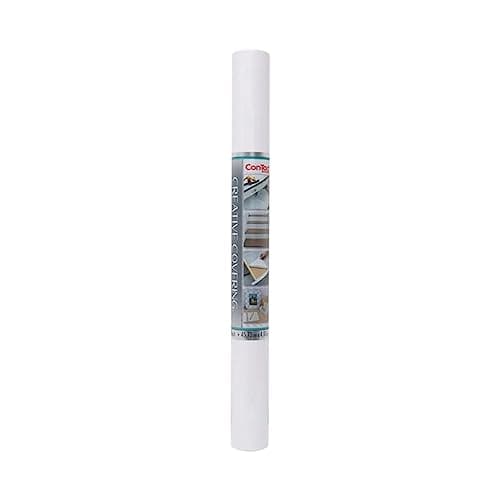
Con-Tact Creative Covering Removable Self-Adhesive Shelf Liner
Con-Tact · Best for drawers and small shelves you want to get straight
8.6
out of 10
The only liner here whose maker publishes both removable and repositionable, and the water-based adhesive is why. Narrower rolls than Duck, far more patterns.
| Specification | Published figure | Source |
|---|---|---|
| Roll size | 18 in x 9 ft and 18 in x 16 ft | Con-Tact published product page |
| Adhesive | Water-based adhesive backing; removable and repositionable, removes without leaving residue | Con-Tact published product page |
| Material | Durable PVC vinyl | Con-Tact published product page |
| Backing | Measure-and-cut backing paper | Con-Tact published product page |
What the specification gets you
- Repositionable is published, so a panel that went on skewed can be lifted and realigned
- Water-based adhesive is the gentler chemistry of the two adhesive liners here
- 18 inches suits drawer bottoms better than a 20-inch roll you have to trim twice
What it does not cover
- 18 inches is narrower than a standard cabinet shelf, so a wide shelf needs a seam
- Individual patterns and sizes go out of stock, so the one you like may not be there
- PVC vinyl is a plastic sheet and looks like one close up, whatever the print says
Coming off the wall
The published claim is the strongest of the three adhesive liners: removable, repositionable, and removes without leaving residue. Repositionable is the useful half -- it means a crooked first attempt is recoverable rather than wasted.
Skip this if
Skip this for a wide kitchen shelf where a seam would sit under everything you put down. Use the 20-inch roll instead.
- Published load
- 7.5
- Fit range
- 7.5
- Reversibility
- 9.0
- Documentation
- 8.5
- Price-to-capability
- 9.0
#ad Price as of September 13, 2026. How we are funded
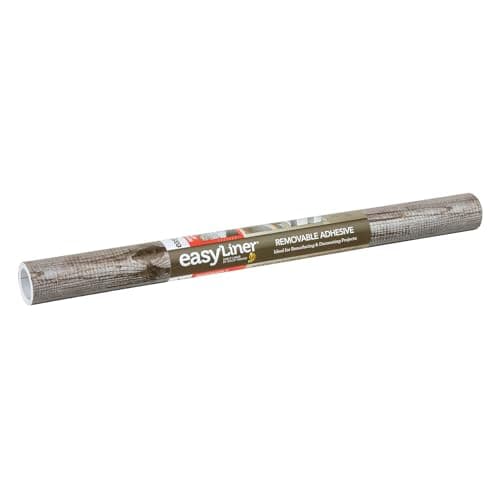
Duck EasyLiner Removable Adhesive Laminate
Duck · Best for resurfacing a shelf you intend to un-resurface
8.4
out of 10
Adhesive laminate the manufacturer itself calls removable, on a 20-inch roll wide enough to line a standard cabinet shelf in one piece.
| Specification | Published figure | Source |
|---|---|---|
| Roll size | 20 in x 15 ft | Duck published product page |
| Adhesive | Self-adhesive laminate, described by the maker as removable from a variety of surfaces | Duck published product page |
| Surfaces | Sticks to smooth, flat surfaces; for covering countertops, drawers or shelves | Duck published product page |
| Backing | Pre-printed paper backing with measure-and-cut guidelines; wipes clean with a damp cloth | Duck published product page |
What the specification gets you
- 20 inches wide covers a standard cabinet shelf in a single piece, so there is no seam to catch
- The maker puts the word removable in the product name, which most adhesive liners do not
- Gridded backing means you can cut accurately without measuring twice
What it does not cover
- Removable is the maker's word rather than a tested one, and no surface list is published for where it will not release
- Adhesive laminate traps air, and a shelf lined in a hurry looks it
- Smooth and flat only -- textured or worn shelves are exactly where it fails to bond and exactly where renters most want it
Coming off the wall
The maker states it is removable from a variety of surfaces, which is not the same as removable from every surface. On melamine and sealed laminate it lifts; on bare chipboard, old varnish or a painted shelf, treat it as permanent until you have tested a corner.
Skip this if
Skip this on any surface you cannot test a corner of first. Stick a small piece, wait a week, lift it: if it releases clean, do the rest.
- Published load
- 7.0
- Fit range
- 8.0
- Reversibility
- 8.0
- Documentation
- 8.0
- Price-to-capability
- 9.0
#ad Price as of September 13, 2026. How we are funded
Questions people actually ask
What is the difference between shelf liner and contact paper?
Contact paper is self-adhesive vinyl that sticks to the shelf and resurfaces it. Shelf liner, in the sense most renters want, is a non-adhesive grip mat that holds itself and the objects on it by friction. One changes how the surface looks; the other only protects it.
Is contact paper safe for rental cabinets?
Sometimes, and there is no way to know in advance for your particular shelf. Adhesive laminate can bond better to a melamine or foil shelf's surface film than that film is bonded to the board, and then it lifts the finish. Test a two-inch square in a back corner for a week before lining anything.
Does removable contact paper really come off?
That is the maker's published wording rather than a tested result, and neither adhesive maker publishes a list of surfaces it will and will not release from. The strongest published claim in this category is removable and repositionable, removes without leaving residue, on a water-based adhesive.
Which is better for kitchen cabinets, shelf liner or contact paper?
In a rental, non-adhesive grip liner for the shelves you have to hand back, because it cannot take the finish with it and it washes when something spills. Contact paper only where you actually want the surface to look different, and only after a corner test.
What width shelf liner do I need?
Match the roll width to the shelf depth so you can lay one piece with no seam. Standard wall cabinets and drawers usually take 12 inches, mid-depth shelves 18 inches, and base or pantry shelves 20 inches. Measure front to back before choosing a pattern.
How do I stop contact paper bubbling?
Peel back only the first two inches of backing, line that leading edge up at the back of the shelf, press it down, then work forward in short pulls smoothing outward from the center. Peeling the whole backing off first is the usual cause, and on a liner that is not repositionable it cannot be undone.