Kitchen & Bath · Guide
Renter-Friendly Kitchen Cabinet Organization
The cabinets are not yours. Everything here goes inside them and comes out again in a box.
By Scooter M. · Published · How we pick

Disclosure · We earn a commission on purchases made through the Amazon links on this page, at no extra cost to you. These picks come from published specifications, not from hands-on use. How this site is funded.
The short answer
The rule for a rental kitchen is simple: everything goes inside the cabinet, nothing is fixed to it. That means shelf risers and stacking racks for vertical space, tension rods for hanging and dividing, expandable under-sink racks that clear the trap, and containers rather than fixed dividers. Adhesive belongs in a kitchen even less than it does in a bathroom: grease film, heat and laminate surfaces all work against it.
Rental kitchens are almost always short of the same thing: usable vertical space inside cabinets that are too tall for one layer of plates and too short for two. Most of the fix is dividing air rather than buying storage.
Line the shelves before you fill them
Do this before anything goes in, because it is far harder afterwards -- and in a rental the choice of liner is a deposit question rather than a decorating one. Adhesive laminate can bond better to a cheap shelf's surface film than that film is bonded to the board underneath. Best adhesive shelf liners compares the two removable adhesive options against the non-adhesive grip liner that usually wins on a shelf you have to hand back.
Inside the cabinets
Shelf risers and stacking racks
A cabinet shelf with 14 inches of clearance and a stack of plates 6 inches tall is wasting half its volume. A riser creates a second level without touching the cabinet, and it is the single highest-value change in most rental kitchens. Look for units that stand on their own legs rather than clip to the shelf edge, because clip-on designs assume a shelf thickness your cabinet may not have. The ranked picks, with what each maker publishes -- from 4.4 lb to 30 lb a shelf on risers that look alike -- are in best kitchen cabinet organizers.
Tension rods, used sideways
A short tension rod set vertically inside a cabinet divides it into slots for baking trays, chopping boards and pan lids -- the flat things that otherwise collapse into a pile. Set horizontally under the sink, the same rod hangs spray bottles by their triggers and frees the whole cabinet floor. Published load on the rod we cover is 2.33 lb, which is several bottles and nothing heavier. Sizing method: tension rod sizing.
Containers instead of dividers
Fixed drawer dividers usually need screws. Bins and containers do the same job, come out in one movement for cleaning, and leave with you. In a rental, the container is almost always the right answer to a problem that a fitted solution would solve slightly better.
Under the sink
The largest unused volume in most rental kitchens, and the one most obstructed. The approach is the same everywhere: measure the opening width, the internal height and the trap position, then choose a rack shape that fits around the plumbing rather than through it. Full method in under-sink clearance, and the ranked racks in best under-sink organizers.
| Problem | Fix | Published figure | Fixings |
|---|---|---|---|
| Tall cabinet, short stacks | Shelf riser or stacking rack | Product-dependent | None |
| Trays and lids collapsing | Tension rod set vertically as dividers | 2.33 lb on the rod we cover | None |
| Cluttered under-sink floor | Expandable 2-tier rack, 15.75-25 in | No load published | None |
| Spray bottles everywhere | Tension rod across the cabinet interior | 2.33 lb | None |
| Loose drawer contents | Containers rather than fitted dividers | n/a | None |
Why adhesive is a poor fit in a kitchen
Three reasons stack up. Cabinet interiors and doors are usually melamine or laminate -- smooth, but not always the smooth the adhesive is specified for, and the finish can lift with the strip. Cooking puts a fine grease film on every surface in the room, which is the same contamination problem as soap film in a bathroom (the mechanism is here). And heat near a stove or oven softens adhesive and encourages creep. A rack that stands or a rod that tensions has none of those failure modes.
On the counter, and above it
Counter space is the scarcest surface in a rental kitchen, so anything that lives on it permanently should earn its place. A narrow freestanding unit at the end of a run of counter -- or in the corner nobody uses -- adds shelves without touching a wall and publishes real load figures (no-drill shelving). Over the door of a pantry or a broom closet, an over-door rack does the same for packets and cloths (over-the-door organizers).
At move-out
The advantage of doing all of this without fixings is that the kitchen undoes itself: racks and rods come out, containers get packed, and the cabinets are exactly as you found them. The one thing worth doing early is checking behind and beneath anything that has stood in place for a year -- the move-out checklist has the order.
What to buy for this
Picked from the same registry as our roundups, on published specification. Nothing here has been tested by us, and we say so on every page.
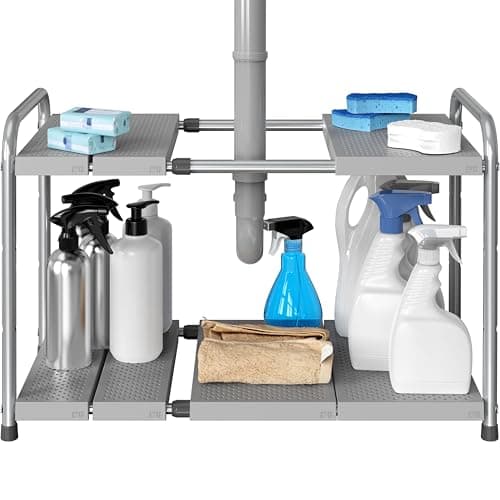
Simple Houseware Under-Sink 2-Tier Expandable Rack
Simple Houseware · Best for a cabinet whose plumbing sits off-center
8.5
out of 10
Adjustable 15.75 to 25 in wide with four shelf height levels, which is the specification that decides whether it clears your drain trap.
| Specification | Published figure | Source |
|---|---|---|
| Adjustable width | 15.75 to 25 in | Simple Houseware product listing |
| Height adjustment | 4 shelf height levels | Simple Houseware product listing |
| Dimensions | 11.75 D x 25 W x 15.25 H in at full extension | Simple Houseware product listing |
| Rated load | Not published for this model, so we are not quoting one. | Simple Houseware product listing |
What the specification gets you
- Four height levels is the feature that matters -- a drain trap sits at a different height in every apartment
- Width adjusts across a 9 in range, which covers most single-door and many double-door cabinets
- Nothing attaches to the cabinet, which is the point in a rental kitchen
What it does not cover
- No published weight rating, which for a shelf holding bottles of liquid is a genuine gap
- The 11.75 in depth assumes the cabinet is that deep behind the door frame -- measure past the hinge
Coming off the wall
It is a free-standing rack inside a cabinet. Lift it out.
Skip this if
Skip this if your trap sits dead center and low. A two-tier rack needs one clear side; a U-shaped single-tier organizer is the shape for a central obstruction.
- Published load
- 3.5
- Fit range
- 9.5
- Reversibility
- 10.0
- Documentation
- 7.0
- Price-to-capability
- 9.0
#ad Price as of October 17, 2026. How we are funded
Kenney Fast Fit Spring Tension Rod
Kenney · Best for voile, a cafe panel, a cupboard curtain
6.4
out of 10
Listed at a 2.33 lb weight capacity. We are including it because that figure is the honest floor of the category, and because most buyers assume the opposite.
| Specification | Published figure | Source |
|---|---|---|
| Rated load | 2.33 lb weight capacity | Kenney Fast Fit product listing (Wayfair) |
| Span and diameter | 18-28 in or 28-48 in adjustable; 7/16 in steel tube | Kenney Fast Fit product listing (Wayfair) |
What the specification gets you
- Cheap in multipacks, which is the right way to buy rods for a whole apartment of small windows
- 7/16 in tube fits shallow reveals where a 1 in rod will not clear the glass
- The published figure is refreshingly unflattering
What it does not cover
- 2.33 lb is a genuinely small number. A single lined panel exceeds it
- Thin tube deflects visibly at the top of its span
Coming off the wall
Compress and lift out.
Skip this if
Skip this for anything but the lightest fabric. If the curtain has a lining, you are already over the published figure -- and this is the pick on this page we would most often tell you not to buy.
- Published load
- 3.0
- Fit range
- 8.0
- Reversibility
- 9.5
- Documentation
- 7.5
- Price-to-capability
- 7.0
#ad Prices change; we show one only when our feed has a live figure. How we are funded
Questions people actually ask
How do I organize rental kitchen cabinets without drilling?
Everything goes inside the cabinet and nothing is fixed to it: shelf risers and stacking racks for vertical space, tension rods set vertically as dividers or horizontally as bottle rails, expandable racks under the sink, and containers instead of fitted dividers.
Can I use adhesive hooks inside kitchen cabinets?
We would avoid it. Cabinet interiors are often laminate or melamine whose finish can lift, cooking leaves a grease film that contaminates the bond, and heat near a stove encourages creep. On a smooth cured painted kitchen wall away from the stove, adhesive hooks are fine.
What is the best use of a tension rod in a kitchen?
Two: set vertically inside a cabinet it divides the space into slots for trays, boards and pan lids; set horizontally under the sink it hangs spray bottles by their triggers and frees the cabinet floor. The rod we cover publishes 2.33 lb.
How do I get more space out of a tall cabinet shelf?
A shelf riser or stacking rack creates a second level in the wasted air above a stack of plates. Prefer units that stand on their own legs over clip-on designs, which assume a shelf thickness your cabinet may not have.
What about the cabinet doors?
Anything screwed to a cabinet door is a hole in the landlord's joinery. Over-the-door racks designed for room doors are usually too thick for cabinet doors, so the practical answer is to keep storage inside the cabinet.