Windows · Guide
What Size Tension Rod Do You Need?
Measure the inside of the opening, then buy the range that comfortably contains it -- not the one that just reaches.
By Scooter M. · Published · How we pick

Disclosure · We earn a commission on purchases made through the Amazon links on this page, at no extra cost to you. These picks come from published specifications, not from hands-on use. How this site is funded.
The short answer
Measure the inside width of the opening at the height the rod will sit, then choose a rod whose published range comfortably brackets that number -- ideally with your measurement near the middle. Common published ranges are 18-28 in, 28-48 in, 42-72 in and 48-84 in. A rod set at the extreme end of its range has minimal engagement and is the one that slips.
How to measure
- Measure inside the opening, not the window. The rod pushes against the two side surfaces of the reveal, so that is the dimension that matters.
- Measure at the height the rod will actually sit. Older openings are not square, and the width at the top can differ from the width at the middle by enough to matter.
- Measure twice, at both ends. If the two numbers differ, use the smaller one -- a rod that will not compress into the narrower point will not go in.
- Check the depth of the reveal. The rod plus the curtain rings plus the fabric all have to clear the glass and any handle. A slim 7/16-inch rod fits shallow reveals where a chunkier rod fouls the window.
Published adjustment ranges
| Published range | Typical use | Example | Published load |
|---|---|---|---|
| 18-28 in | Cupboard curtains, small windows, cafe panels | Kenney Fast Fit | 2.33 lb |
| 28-48 in | A standard bedroom or living room window | Kenney Strafford | 22 lb |
| 28-48 in | The same window, lighter fabric | Kenney Rogers Twist & Fit | 4 lb |
| 42-72 in | A tub alcove for a shower curtain | Kenney KN609L/1 | 7.5 lb |
| 48-84 in | Wide windows, patio doors | Kenney Rogers Twist & Fit | 7 lb |
Why the middle of the range matters
A spring tension rod holds by pushing outward; a twist-and-fit holds by a thread that extends the tube. Either way, an extended rod has less overlap between its two sections and less spring travel in reserve. Set at the very top of its published range it is simultaneously at its weakest overlap and its lowest reserve tension, which is why a rod that "just fits" is the one that creeps down the wall over a couple of weeks. Buy the range that puts your opening comfortably inside it.
The same rod, elsewhere in the apartment
Tension rods are the most transferable product on this site. The same measurement method gets you a closet rod for hanging clothes (see apartment closet organization), a shower curtain rod across a tub alcove, or a rod under a sink to hang spray bottles from. Every rod we cover, ranked by the load its maker publishes, is in best tension rods, by load. The only thing that changes is what you check the published load against -- a wet shower liner is a very different load from a set of sheers, which is why the load table is the companion to this page. In a closet a tension rod is one of several ways to add a rail, and not always the strongest -- best no-drill closet systems ranks it against rod doublers and freestanding racks on published load.
Picking the rod itself
Sizing tells you the span; it does not tell you which rod to buy at that span. Best tension rods, by load is the ranking, and the short version is that two rods of the same length in the same aisle can publish 2.33 lb and 22 lb.
Fitting it so it stays
Wipe both contact surfaces clean and dry first -- dust is a lubricant. Set the rod a little longer than the opening, compress it into place, then check it is level. If it is a twist-and-fit, extend it against the surfaces rather than setting the length first and forcing it in. Then load it and check it again the next day: creep shows up early, and a rod that has moved in 24 hours will move again. Step by step, with the curtain, in how to hang curtains without drilling.
What to buy for this
Picked from the same registry as our roundups, on published specification. Nothing here has been tested by us, and we say so on every page.
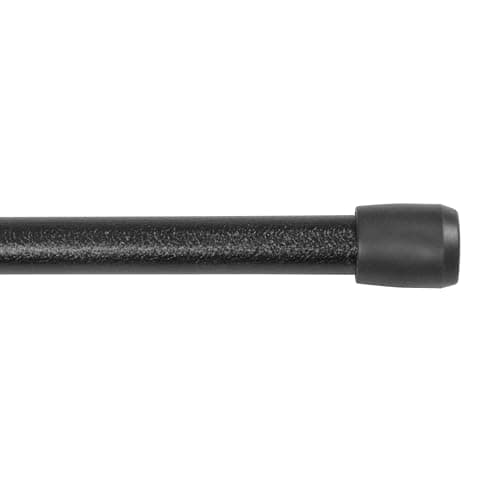
Kenney Strafford Spring Tension Rod (28-48 in)
Kenney · Best for inside-mount curtains on a 28-48 in opening
9.0
out of 10
22 lb published on a spring tension rod is an outlier figure, and it is the reason to read ratings per model rather than assume tension rods are all the same.
| Specification | Published figure | Source |
|---|---|---|
| Rated load | 22 lb maximum weight | Kenney Strafford product listing (Lowe's) |
| Span | Adjustable 28 to 48 in | Kenney Strafford product listing (Lowe's) |
What the specification gets you
- 22 lb published is far above the 2 to 7 lb figures on the light twist-and-fit rods
- Inside mount means no bracket, no trim requirement and no contact with the wall face at all
- The span range covers the standard bedroom window without a cut
What it does not cover
- A tension rod holds by friction against two surfaces, so a painted reveal that is slick or textured changes the outcome and no rating covers that
- Inside mount only -- it cannot hang wider than the opening, which is how you lose light control at the edges
Coming off the wall
Twist to shorten and lift out. On a painted reveal, the rubber end caps can leave a burnished ring where they have been under compression -- it usually wipes off.
Skip this if
Skip this if you need the curtain to overhang the window opening. Tension lives inside the reveal by definition; overhang needs a bracket.
- Published load
- 10.0
- Fit range
- 7.5
- Reversibility
- 9.5
- Documentation
- 8.0
- Price-to-capability
- 9.0
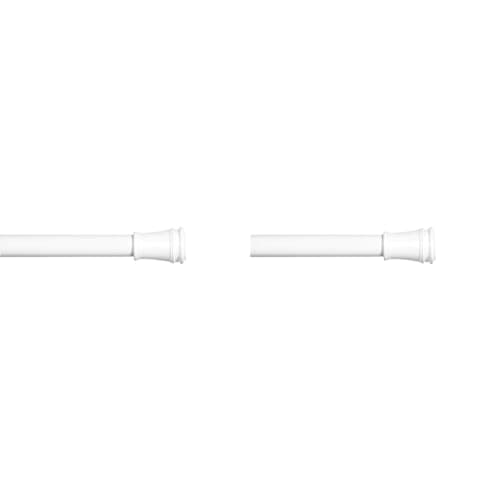
Kenney Rogers Twist & Fit No Tools Tension Rod
Kenney · Best for sheers, cafe curtains and light panels
7.9
out of 10
Published at a maximum recommended load of 4 lb on the 28-48 in size and 7 lb on the 48-84 in. Sheers and light panels -- and Kenney says so on the listing.
| Specification | Published figure | Source |
|---|---|---|
| Rated load | Maximum recommended load 4 lb (28-48 in); 7 lb (48-84 in) | Kenney KN634 product listing |
| Span | 28-48 in and 48-84 in versions | Kenney KN634 product listing |
| Diameter | 5/8 in | Kenney Rogers product listing (Walmart) |
What the specification gets you
- Publishes a maximum recommended load per length, which most tension rods do not
- The longer version is rated higher, which tells you the figure is about the rod and not just the mechanism
- No tools, no bracket, no trim requirement
What it does not cover
- 4 lb will not hold blackout drapes. The rating is not a formality here
- The longer the span, the more a mid-span load turns into deflection rather than grip
Coming off the wall
Twist to release tension, lift out. Nothing left behind on a sound painted reveal.
Skip this if
Skip this for lined or blackout curtains -- at 4 lb you are over the published figure before the second panel is on the rod. Use the 22 lb Strafford or a Kwik-Hang bracket.
- Published load
- 5.5
- Fit range
- 9.0
- Reversibility
- 9.5
- Documentation
- 9.0
- Price-to-capability
- 8.0
#ad Price as of October 17, 2026. How we are funded
Questions people actually ask
What size tension rod do I need?
Measure the inside width of the opening at the height the rod will sit, then buy a rod whose published range comfortably brackets that measurement -- ideally with your number near the middle rather than at either end.
What is the longest tension rod?
Among the rods we cover, published ranges reach 84 inches. Wider than that and tension stops being the right mechanism -- a bracket system with a center support is the option that scales.
What is the shortest tension rod?
Published ranges start around 18 inches for the small multipack rods intended for cupboards, cafe curtains and small windows.
Should I buy a rod that just fits my window?
No. A rod set at the extreme of its range has minimal overlap between its sections and little reserve tension, which is exactly the configuration that slips. Choose a range that contains your opening comfortably.
Does rod diameter matter?
For fit, yes -- a slim 7/16-inch tube clears shallow reveals that a chunkier rod fouls. For load, diameter correlates with capacity but does not determine it: read the published figure for the specific model.