Closets · Roundup
Best No-Drill Closet Systems
Five ways to add hanging and shelf space to a closet you are not allowed to touch, ranked on published load and on where that load ends up.
By Scooter M. · Published · How we pick

Disclosure · We earn a commission on purchases made through the Amazon links on this page, at no extra cost to you. These picks come from published specifications, not from hands-on use. How this site is funded.
Quick picks
Ranked on published specification, not on hands-on use. Tap a row for the full write-up.
| # | Product | Best for | Score | Price |
|---|---|---|---|---|
| 1 | Honey-Can-Do Hanging Closet Rod (HNG-09139) Best first move, 50 lb published | Doubling the hanging space under short garments | 8.8out of 10 | Check price on Amazon #ad Prices change; we show one only when our feed has a live figure. How we are funded |
| 2 | Whitmor Commercial Chrome Garment Rack Highest published load, 150 lb | Coats and dense wardrobes with nowhere to go | 9.0out of 10 | Check price on Amazon #ad Prices change; we show one only when our feed has a live figure. How we are funded |
| 3 | 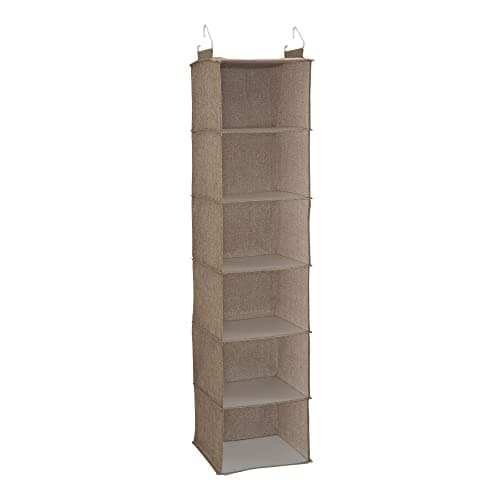 Household Essentials 6-Shelf Hanging Closet Organizer Most shelves per inch of rod | Folded clothes in a closet with no shelf | 8.0out of 10 | |
| 4 | 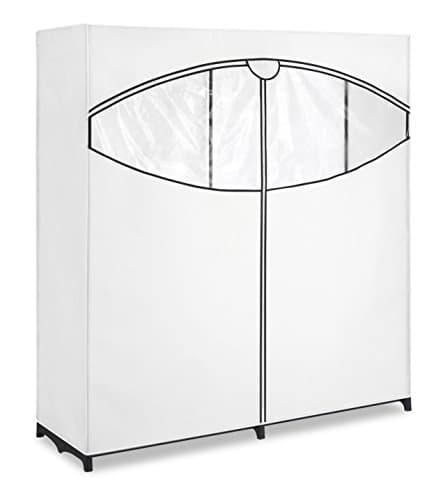 Whitmor Extra-Wide Clothes Closet Best when there is no closet at all | A room with no closet, or clothes you want covered | 8.2out of 10 | $52.99 · View on Amazon #ad Price as of October 17, 2026. How we are funded |
| 5 | 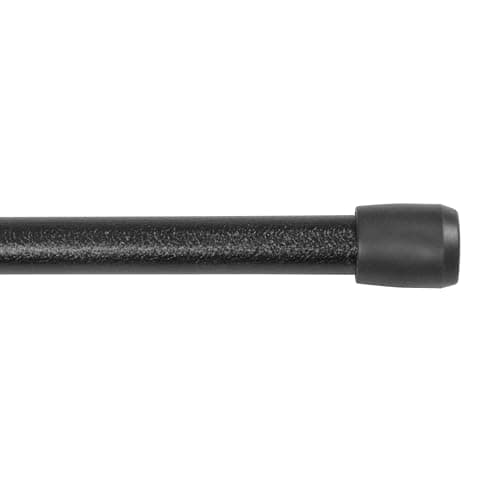 Kenney Strafford Spring Tension Rod (28-48 in) A rail where there is none, 22 lb | Inside-mount curtains on a 28-48 in opening | 9.0out of 10 |
A rental closet is a rod, a shelf and a door, and none of the three is where you would have put them. The rod sits at whatever height the builder chose. The shelf above it is a single deep ledge you cannot see the back of. The whole thing was sized for somebody else's wardrobe, and you are not allowed to move any of it.
Everything on this page fixes that without a fixing. Each option does one of three things: it hangs from the rod you already have, it stands on the floor, or it presses between two surfaces. Which of the three it does is the most useful fact about any closet product, because it tells you where the weight ends up -- and that, not capacity, is what actually goes wrong. Four of these five publish a load figure. One publishes none at all, and this page says so rather than filling the gap with a guess.
Where the weight goes is the whole decision
A closet rod doubler rated to 50 lb does not add 50 lb of capacity to your closet. It adds 50 lb of load to the rod that is already there -- a rod nobody rated, installed by a contractor you will never meet, into sockets you cannot inspect. That is the single most important thing on this page and almost nobody says it. A freestanding rack rated to 150 lb, by contrast, puts every pound of that straight into the floor, which is the one structural element in a rental you can rely on completely.
So read the table below in two columns at once. The published load matters, but the column next to it -- what the load rests on -- decides whether the published figure is the number that will actually govern the outcome.
| Option | What it rests on | Published load | Published size |
|---|---|---|---|
| Honey-Can-Do hanging closet rod | Your existing closet rod | 50 lb | 23 x 1 x 35 in |
| Whitmor commercial garment rack | The floor, on casters | 150 lb on up to 74.5 in of rod | 51-74.5 W x 66.25-71.25 H x 22 D in |
| Household Essentials 6-shelf organizer | Your existing closet rod | Not published | 12 x 12 x 50 in, 12 in of rod used |
| Whitmor extra-wide clothes closet | The floor | 50 lb of hanging clothing | 60 W x 64 H x 19.5 D in |
| Kenney Strafford tension rod | Two opposing surfaces, by friction | 22 lb | Adjustable 28-48 in |
How these are ranked
Published load first, weighted by how much of that load the product can honestly claim to control. Then fit -- whether it works in an ordinary rental closet rather than a walk-in. Then footprint, because in a small apartment floor area is more expensive than closet space. Then reversibility, which is total for all five, and finally how well the maker documents the thing. Nothing on this page has been tested by us; every figure comes from the manufacturer or the retailer listing and is cited on each card. The full method is here.
The four things that decide it
1. The rod you already have
Before you buy anything that hangs, put both hands on your closet rod and pull down hard. If it flexes visibly, turns in its sockets, or the sockets move in the wall, a doubler is the wrong purchase -- you would be doubling the load on the part that is already the weakest. Check the rod shape too: the hanging options here are listed as fitting round and oval rods and wire shelving, which covers most rentals but not square or track-style rails.
2. Long garments against short
A rod doubler only pays off under things that do not reach the floor. Shirts, folded trousers over a bar, jackets that end at the hip: these leave 35 inches of dead air beneath them, and that is exactly what the doubler reclaims. Coats, dresses and anything full length leave nothing underneath, so the same product returns nothing. Count the long garments in your closet before you order. If they are more than about a third of what is hanging, buy floor space rather than a second rail.
3. Floor area you can actually give up
The commercial rack is 22 inches deep and up to 74.5 inches wide. The clothes closet is 60 inches wide. Those are honest numbers for what they hold, and they are also most of a wall in a one-bedroom. Measure the floor before you fall for the load rating -- a rack that solves the closet problem by relocating it into the middle of the bedroom is not a solution in a studio. This is the same trade as freestanding shelving, where capacity is bought with floor.
4. Covered or open
An open rack shows you everything, which is good for getting dressed and bad for a room you also sleep in. It also collects dust in a way a closed closet does not. A fabric wardrobe with a zippered cover fixes both and costs you height: at 64 inches overall, full-length garments will not hang clear inside it. There is no version of this trade where you get all three of visible, covered and tall.
Shelves are the half of the closet nobody adds
Almost every renter fixes hanging space and leaves folded clothes in a heap on the one deep shelf above the rod. A hanging shelf tower is the cheapest correction there is: the six-shelf organizer takes 12 inches of rod and returns six compartments of 11.75 by 7.75 by 11.75 inches, which is the densest storage-per-inch trade on this page.
The honest caveat is that no weight capacity is published for it anywhere we could find, and fabric shelves sag. That makes it right for sweaters, t-shirts and folded knitwear and wrong for books, shoes and anything with a hard edge. When something dense needs a home, it belongs on a shelf that publishes a figure -- the load ratings for those are in how much weight a no-drill shelf really holds.
The tension rod is a different tool, not a cheaper one
The Strafford rod publishes 22 lb, which is high for a spring tension rod and low next to everything else on this page. It earns its place because it does something none of the others can: it puts a rail across an alcove, a recess or a doorway where there is no rod at all and no floor to stand on. That is the wardrobe-shaped hole in a lot of older rentals.
Its weakness is that friction is not a rating. A tension rod holds because two surfaces squeeze it, and a slick painted reveal, a textured wall or a slightly out-of-square opening changes the result in a way no published figure covers. If you are using one as a hanging rail rather than for curtains, span matters more than usual -- the shorter you can set it, the better it behaves. The full picture is in how much weight a tension rod holds.
What we would skip
The chrome version of the rod doubler. It is the same idea from the same brand, it is more widely stocked, and it adjusts in width where the black one does not -- but the maker publishes a weight capacity for the black model and publishes none for the chrome one. On a product whose entire job is to carry load on hardware you did not install, the version that documents the load is the version to buy. Paying a little more for a published number is the whole editorial position of this site in one purchase.
We would also skip any rod doubler at all in a closet full of long garments, and we would skip a 60-inch wardrobe in a room that cannot spare 60 inches. Both are good products bought for the wrong closet, which is how most of the returns in this category happen.
Going further freestanding
The two freestanding options on this page are each the top of their own category, and both have a dedicated ranking. Best garment racks runs the open racks from 30 lb to 330 lb published, and best portable closets covers the covered wardrobes -- where the honest headline is that almost none of them publishes a load figure at all.
What a no-drill closet system cannot do
None of this adds structure. A doubler and a shelf tower borrow capacity from a rod nobody rated; a rack and a wardrobe borrow floor. If the closet is genuinely too small for what you own, the honest answer is fewer garments or a bigger footprint, not a cleverer product. Nothing here is a substitute for a wall fixing either -- if you need a load-bearing point on a wall, that is a conversation with your landlord, not a product decision.
Two adjacent moves usually beat buying a third closet product. The back of the closet door is dead space and takes a rack that touches no wall at all -- the over-the-door options are here, decided by the thickness of your door edge. And the largest free volume in the room is under the bed, where under-bed storage is decided by the clearance beneath the frame. Between the rod, the door and the bed, most rental bedrooms have more capacity than the closet suggests. The room-by-room order for working through them is in small-apartment storage.
The picks in full
Every figure below is published by the manufacturer or the retailer listing named beside it. Where a figure is not published, the row says so rather than carrying an estimate.
#1 · Best first move, 50 lb published
Honey-Can-Do Hanging Closet Rod (HNG-09139)
Honey-Can-Do · Best for doubling the hanging space under short garments
8.8
out of 10
The only rod doubler in this class we found that publishes a weight capacity at all -- 50 lb -- and it is the cheapest way to add hanging space to a closet you are not allowed to touch.
| Specification | Published figure | Source |
|---|---|---|
| Rated load | 50 lb weight capacity | Honey-Can-Do published product page |
| Dimensions | 23 in L x 1 in W x 35 in H, with an adjustable bar | Honey-Can-Do published product page |
| Fitting | Two hooks over the existing rod. No tools | Honey-Can-Do published product page |
What the specification gets you
- 50 lb published is a real number in a category where most listings publish none at all
- Adds roughly a second full rail of hanging space in a closet you cannot modify
- Hangs and unhangs in seconds, so it moves with you and can be repositioned as the closet changes
What it does not cover
- The 50 lb it holds is 50 lb added to your existing closet rod, and that rod has its own limit which nobody published when the building went up
- Only works under garments short enough to leave room beneath -- shirts and folded pants, not coats or dresses
- At 35 in tall it needs the upper rail to sit high enough that the lower rail still clears the closet floor
Coming off the wall
Lift the two hooks off the rod. It never touches a wall, a door or a ceiling, so there is nothing to leave behind and nothing to make good.
Skip this if
Skip this if your closet is mostly long garments, or if the existing rod already sags or turns in its sockets under the load it carries now. A doubler is a load multiplier on hardware you did not install.
- Published load
- 9.0
- Fit range
- 7.5
- Reversibility
- 10.0
- Documentation
- 8.5
- Price-to-capability
- 9.5
#ad Prices change; we show one only when our feed has a live figure. How we are funded
#2 · Highest published load, 150 lb
Whitmor Commercial Chrome Garment Rack
Whitmor · Best for coats and dense wardrobes with nowhere to go
9.0
out of 10
150 lb across up to 74.5 inches of rod is the highest published load anywhere on this site, and it is the answer when the closet is simply too small to fix.
| Specification | Published figure | Source |
|---|---|---|
| Rated load | Holds up to 150 lb on up to 74.5 in of hanging rod | Whitmor product listing (Organize-It) |
| Dimensions | 51 to 74.5 in wide, 66.25 to 71.25 in high, 22 in deep | Whitmor product listing (Organize-It) |
| Folded size | 52 x 22.25 x 3.5 in | Whitmor product listing (Organize-It) |
What the specification gets you
- 150 lb published, on a published length of rod -- both halves of the figure, which is rare
- Adjustable in width and height, so it fits an alcove rather than demanding a whole wall
- Folds flat for the move, which matters when the next apartment has a better closet
What it does not cover
- 22 inches deep and up to 74.5 inches wide is a large object in a small room, and open racks show every garment you own
- Casters on carpet leave indentations, and a loaded rack on a soft floor will settle into them
- No cover, so contents collect dust in a way a closet does not
Coming off the wall
It stands on casters and folds flat to 3.5 inches. Nothing touches a wall, so the only mark it can leave is caster indentation in carpet.
Skip this if
Skip this if the room cannot give up the floor area. A rack this size solves the closet problem by moving it into the bedroom, and in a studio that trade is usually a bad one.
- Published load
- 10.0
- Fit range
- 8.5
- Reversibility
- 9.5
- Documentation
- 9.0
- Price-to-capability
- 7.5
#ad Prices change; we show one only when our feed has a live figure. How we are funded
#3 · Most shelves per inch of rod
Household Essentials 6-Shelf Hanging Closet Organizer
Household Essentials · Best for folded clothes in a closet with no shelf
8.0
out of 10
Six shelves for 12 inches of rod is the best space trade on this page, and the listing is specific about the compartment size -- which matters more than the tower's overall height.
| Specification | Published figure | Source |
|---|---|---|
| Dimensions | 12 in W x 12 in D x 50 in H | Household Essentials product listing (Organize-It) |
| Compartment size | 11.75 in wide x 7.75 in high x 11.75 in deep, six of them | Household Essentials product listing (Organize-It) |
| Rod space used | 12 in of closet rod; fits round and oval rods and wire shelving | Household Essentials product listing (Organize-It) |
| Rated load | Not published | No weight capacity is stated on the listing |
What the specification gets you
- Six compartments for 12 inches of rod, which is the densest storage-per-inch trade on this page
- The compartment dimensions are published, so you can check a folded sweater against them before you buy
- Works on wire shelving as well as a round or oval rod, which covers most rental closets
What it does not cover
- No weight capacity is published anywhere, so how much you can load it with is a judgment call rather than a documented figure
- Fabric shelves sag under dense items -- this is a sweater and t-shirt tower, not a book or shoe tower
- 50 inches of drop needs a rod high enough to clear the floor once loaded
Coming off the wall
Unhook it from the rod and fold it. Nothing is fixed to anything.
Skip this if
Skip this if what you need to store is heavy or hard-edged. With no published load rating, anything dense goes on a shelf that publishes a number instead.
- Published load
- 4.0
- Fit range
- 9.0
- Reversibility
- 10.0
- Documentation
- 7.5
- Price-to-capability
- 9.5
#4 · Best when there is no closet at all
Whitmor Extra-Wide Clothes Closet
Whitmor · Best for a room with no closet, or clothes you want covered
8.2
out of 10
A covered 60-inch wardrobe rated to 50 lb of hanging clothing, assembled without tools. This is the pick for a bedroom that has no closet at all.
| Specification | Published figure | Source |
|---|---|---|
| Rated load | Up to 50 lb of hanging clothing | Whitmor product listing (Organize-It) |
| Dimensions | 60 in W x 64 in H x 19.5 in D | Whitmor product listing (Organize-It) |
| Cover | Breathable white polyester, zippered front, clear vinyl window | Whitmor product listing (Organize-It) |
What the specification gets you
- Publishes a hanging load, which most fabric wardrobes do not
- The cover keeps dust off, which is the one thing an open rack cannot do
- No tools for assembly, and it breaks back down for the move
What it does not cover
- 64 inches tall is shorter than a garment rack, so full-length coats and dresses will not hang clear
- A fabric-and-pole wardrobe leans if it is loaded unevenly, and 50 lb is the whole unit rather than per rail
- 60 inches wide is most of a wall in a small bedroom
Coming off the wall
It stands on the floor and comes apart without tools. Nothing is fixed to the building at any point.
Skip this if
Skip this if you mainly hang long garments -- at 64 inches overall, the usable drop under the rail is short. A tall open rack clears them and this does not.
- Published load
- 8.0
- Fit range
- 6.5
- Reversibility
- 10.0
- Documentation
- 8.0
- Price-to-capability
- 8.5
#ad Price as of October 17, 2026. How we are funded
#5 · A rail where there is none, 22 lb
Kenney Strafford Spring Tension Rod (28-48 in)
Kenney · Best for inside-mount curtains on a 28-48 in opening
9.0
out of 10
22 lb published on a spring tension rod is an outlier figure, and it is the reason to read ratings per model rather than assume tension rods are all the same.
| Specification | Published figure | Source |
|---|---|---|
| Rated load | 22 lb maximum weight | Kenney Strafford product listing (Lowe's) |
| Span | Adjustable 28 to 48 in | Kenney Strafford product listing (Lowe's) |
What the specification gets you
- 22 lb published is far above the 2 to 7 lb figures on the light twist-and-fit rods
- Inside mount means no bracket, no trim requirement and no contact with the wall face at all
- The span range covers the standard bedroom window without a cut
What it does not cover
- A tension rod holds by friction against two surfaces, so a painted reveal that is slick or textured changes the outcome and no rating covers that
- Inside mount only -- it cannot hang wider than the opening, which is how you lose light control at the edges
Coming off the wall
Twist to shorten and lift out. On a painted reveal, the rubber end caps can leave a burnished ring where they have been under compression -- it usually wipes off.
Skip this if
Skip this if you need the curtain to overhang the window opening. Tension lives inside the reveal by definition; overhang needs a bracket.
- Published load
- 10.0
- Fit range
- 7.5
- Reversibility
- 9.5
- Documentation
- 8.0
- Price-to-capability
- 9.0
Questions people actually ask
How much weight can a hanging closet rod doubler hold?
The one we rank first publishes 50 lb. Most competing doublers publish no figure at all. The more important limit is the rod it hangs from: a doubler transfers its whole load into your existing closet rod and its wall sockets, and that assembly is not rated anywhere.
Will a closet rod doubler damage the closet?
It cannot mark a wall, because it never touches one -- it hooks over the existing rod and lifts straight off. The risk is not cosmetic, it is structural: too much added weight can pull a rod socket out of the drywall, and that is a repair rather than a wipe-down.
Do rod doublers work with long clothes?
No. A doubler reclaims the empty space beneath short garments, so it needs shirts, jackets or folded trousers above it. Under coats and dresses there is nothing to reclaim. If long garments are more than about a third of your closet, buy floor space instead.
What holds the most weight without drilling?
The freestanding commercial rack, at a published 150 lb across up to 74.5 inches of hanging rod. It puts every pound into the floor rather than into the building, which is why it can publish a figure that high.
How much closet rod does a hanging shelf organizer take up?
The six-shelf tower we cover is listed at 12 inches of rod for six compartments of 11.75 by 7.75 by 11.75 inches. That is the densest exchange of rail for storage on this page.
Can I put books or shoes in a hanging fabric organizer?
We would not. No weight capacity is published for it, and fabric shelves sag under dense loads. It is a sweater and t-shirt tower. Anything heavy belongs on a shelf that publishes a rating.
Is a portable wardrobe better than a garment rack?
It depends on what you are protecting. The fabric wardrobe publishes 50 lb of hanging clothing and keeps dust off, but at 64 inches overall it is too short for full-length garments. The open rack publishes 150 lb and takes long coats, but shows everything and collects dust.
Can a tension rod be used as a closet hanging rail?
Yes, and the model we rank fifth publishes 22 lb, which is high for a spring tension rod. It is the only option here that works in an alcove with no existing rod and no floor to spare. Friction is not a rating, though: a slick or textured surface changes the outcome and no published figure covers that.
Sources
- Honey-Can-Do Hanging Closet Rod HNG-09139 -- published 50 lb capacity and dimensions (manufacturer)
- Honey-Can-Do Chrome Adjustable Hanging Closet Rod HNG-09071 -- dimensions published, no capacity published (manufacturer)
- Whitmor Commercial Chrome Garment Rack -- published 150 lb on up to 74.5 in of rod, product listing
- Whitmor Extra-Wide Clothes Closet -- published 50 lb of hanging clothing, product listing
- Household Essentials 6-Shelf Hanging Closet Organizer -- published dimensions and compartment size, product listing
- Kenney Strafford Spring Tension Rod 28-48 in -- published 22 lb, product listing