Hanging · Guide
What Surfaces Actually Hold an Adhesive Hook
One matrix for the dozen near-identical questions -- will it stick to brick, to textured paint, to wallpaper, in the shower.
By Scooter M. · Published · How we pick
Disclosure · We earn a commission on purchases made through the Amazon links on this page, at no extra cost to you. These picks come from published specifications, not from hands-on use. How this site is funded.
The short answer
Adhesive hooks are published for smooth, solid, fully cured surfaces: painted drywall, finished wood, tile, glass, metal and painted cinder block. Command's own guidance says they are not recommended for textured walls, wallpaper, brick, rough or non-stick surfaces, or fabric. On an excluded surface there is no rated load, so nothing you hang there is rated at all.
People ask this question a surface at a time -- will it stick to brick, will it stick to concrete, does it work on textured walls, can I use it on wallpaper, can I use it in the shower -- and every one of those gets answered separately somewhere on the internet. They are one question, and this is one table.
The surface matrix
| Surface | Published for it? | What decides it | If not, use this instead |
|---|---|---|---|
| Painted drywall, smooth and cured | Yes | Cure time. Fresh paint is the most common failure on an otherwise ideal wall | -- |
| Finished wood | Yes | Finish, not species -- a sealed, smooth finish behaves like paint | -- |
| Tile and glass | Yes | The easiest surfaces here: nothing to peel off on removal | -- |
| Metal | Yes | Must be clean and free of oil film | -- |
| Painted cinder block | Yes, if smooth | Whether the paint has filled the pores. Rough block is not a smooth surface | Over-the-door, tension or freestanding |
| Textured paint (orange peel, knockdown) | No | Contact area. The adhesive touches the peaks and bridges the valleys | Over-the-door hooks; tension rods; freestanding shelving |
| Brick | No | Porous and irregular -- Command states its products will not stick to brick | Brick clamps, or a freestanding unit |
| Wallpaper (paper or delicate) | No | Removal, not holding. The adhesive can be stronger than the paper's bond to the wall | Over-the-door; tension; freestanding |
| Vinyl wallpaper | Not guaranteed | Finish varies by product; the manufacturer advises caution and does not guarantee clean removal | Test somewhere invisible, or avoid |
| Inside a shower | Only the water-resistant range | Water and heat at the glue line -- indoor strips are not specified for it | Water-resistant Bath products; tension or freestanding caddies |
| Outdoors | Only the outdoor range | Temperature swing and UV. Indoor products are not specified outside | Outdoor-rated products only |
| Fabric, non-stick and rough surfaces | No | Nothing for the adhesive to bond to | A different mounting method entirely |
When one has already let go
Surface is one of five causes, and the failed strip usually tells you which one you had. Why command hooks fall off has the diagnosis table and the product that fixes each case.
Textured walls: the most common disappointment
Rental drywall is very often sprayed with an orange-peel or knockdown texture, and it is the surface that defeats adhesive most reliably. The reason is geometric rather than chemical: adhesive works by contact area, and on a textured wall the strip only touches the high points. A strip that would have had square inches of contact on smooth drywall might have a fraction of that, and the published rating -- which assumes full contact -- simply does not describe the situation.
If your walls are textured, the good news is that the two highest-capacity renter-proof categories on this site do not care at all. Over-the-door systems publish up to 5 lb per hook and touch no wall (the over-the-door roundup), and freestanding shelving publishes 11 to 66 lb per shelf (no-drill shelving).
Wallpaper is a removal problem, not a holding problem
Adhesive often holds perfectly well on wallpaper. The trouble arrives at the other end: the bond between the strip and the paper can exceed the bond between the paper and the wall, so the strip comes off and brings a strip of wallpaper with it. The manufacturer advises caution and does not guarantee clean removal, including on vinyl papers, whose finishes vary. In a rental with papered walls, treat every adhesive product as a risk to the paper rather than a risk to the paint, and read what removal actually takes with it before committing.
Showers and bathrooms
There is a water-resistant product range for a reason: the standard indoor strips are not specified for a wet environment. If you are mounting inside a shower enclosure, the water-resistant caddies are the only adhesive products on this site we would use, and even then a tension or freestanding caddy avoids the question entirely. The physics of why steam beats glue is in why adhesive fails in bathrooms, and the alternatives are ranked in no-drill shower caddies.
The cinderblock exception
Bare, rough block is outside what any adhesive publishes for. Painted block is the interesting case, and one product names it directly: the 15 lb X-Large utility hook lists painted concrete cinder blocks and concrete surfaces among the surfaces it holds on. That matters most in student housing, which is why it is the first move in dorm storage that survives move-out.
How to test a wall for a dollar
Buy a pack of the 0.5 lb small hooks. Mount one somewhere out of sight -- behind a door, low on a wall -- press it for the time the instructions state, wait an hour, and hang something that weighs a fraction of a pound. If it holds for a day, your wall is a surface adhesive can work with, and you can spend money on the sizes that matter with some confidence. If it lets go, you have learned that for the price of a coffee rather than at the expense of a mirror. The ratings themselves are in the weight limits table.
The same surface list governs the lightest thing in the range. Cable management compares cord clips, raceway and boxes on what each one publishes -- including which adhesives state a clean-removal method and which state none at all.
It also governs the job most likely to be attempted on the worst wall in the home. Broom and mop holders are usually wanted in a utility space or a garage, where the wall is bare block, render or unpainted board -- none of which is on the list above. That page covers the published handle-diameter windows and the over-door racks that need no surface at all.
What to buy for this
Picked from the same registry as our roundups, on published specification. Nothing here has been tested by us, and we say so on every page.
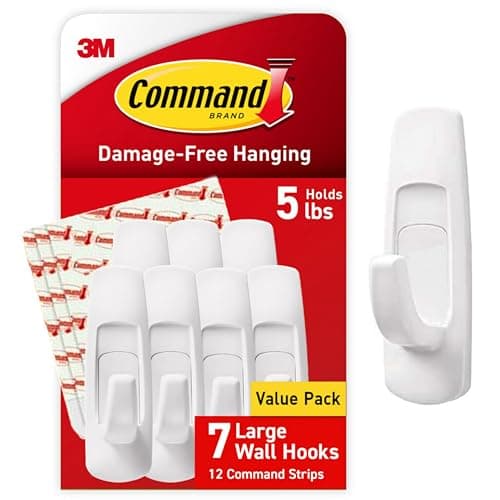
Command Large Utility Hook (17003)
Command · Best for coats, bath towels, backpacks under 5 lb
9.1
out of 10
5 lb with a deep plastic throat, which is the difference between holding a coat and holding a coat that stays on the hook.
| Specification | Published figure | Source |
|---|---|---|
| Rated load | 5 lb | Command 17003 product listing |
| Mounting | One hook, two large adhesive strips per hook | Command 17003 product listing |
| Surfaces | Smooth, solid, fully cured painted surfaces, finished wood, tile, metal, painted cinder block. Not textured, wallpaper, brick, rough or non-stick surfaces, or fabric. | Command brand published surface guidance |
What the specification gets you
- 5 lb is the highest rating in the mainstream hook range before you get to the jumbo, and it covers a wet bath towel with margin
- The plastic throat is deep enough that a coat loop does not walk off it
- Two strips per hook spreads the load over more adhesive area than the small and medium sizes
What it does not cover
- The deeper throat sits further off the wall, so it fouls a door swing more readily than a wire hook
- Nothing published covers repeated shock loading -- yanking a coat down is not the load the rating describes
Coming off the wall
Slow straight-down pull on the tab. Two strips means two tabs -- pull them one at a time, not together.
Skip this if
Skip this on a bathroom wall that steams up daily. The water-resistant Bath line exists precisely because the standard indoor adhesive is not the one for that room.
- Published load
- 9.0
- Fit range
- 8.0
- Reversibility
- 9.5
- Documentation
- 9.0
- Price-to-capability
- 9.0
Command Bath Corner Caddy (BATH12-ES)
Command · Best for a shower corner where nothing else can mount
8.0
out of 10
The water-resistant Bath line is a different adhesive from the indoor strips, and this is the only adhesive product on this site we would put inside a shower at all.
| Specification | Published figure | Source |
|---|---|---|
| Rated load | 7.5 lb on the product listing; a second listing for the same caddy quotes 6.5 lb. We publish both rather than pick one. | Command BATH12-ES product listing |
| Mounting | Command water-resistant strips (a different adhesive from the indoor strips) | Command BATH12-ES product listing |
What the specification gets you
- Water-resistant strips are specified for the wet environment; the standard indoor strips are not
- Corner geometry uses the one part of a shower enclosure nothing else occupies
- On tile or glass, removal has essentially nothing to damage
What it does not cover
- The published rating is inconsistent between listings (7.5 lb and 6.5 lb), which is exactly the sort of thing nobody flags
- Adhesive in a shower is the hardest job on this site -- heat, water and soap film all work against it
Coming off the wall
Straight-down pull, same as the indoor line. Tile and glass are the friendliest surfaces on this site for removal -- there is no paint to take with it.
Skip this if
Skip this if your shower walls are textured, or if the surface never fully dries between uses. A freestanding or tension caddy touches nothing and cannot let go.
- Published load
- 8.5
- Fit range
- 7.0
- Reversibility
- 9.5
- Documentation
- 6.5
- Price-to-capability
- 8.5
#ad Prices change; we show one only when our feed has a live figure. How we are funded
Questions people actually ask
Will adhesive hooks stick to brick?
No. Command states its products will not stick to brick -- they are intended for smooth, solid surfaces, and brick is porous and irregular. There is no published rating for brick, so anything hung there is unrated.
Do adhesive hooks work on textured walls?
The manufacturer says they should not be used on textured walls. Adhesive works by contact area, and on a textured surface the strip only touches the high points, so the published rating no longer describes the situation.
Can you use adhesive hooks on wallpaper?
Command advises against it on delicate or paper wallpapers and does not guarantee results on vinyl wallpaper, because finishes vary. The risk is at removal: the strip's bond to the paper can be stronger than the paper's bond to the wall.
Can you use adhesive hooks in the shower?
Only the water-resistant range. The standard indoor strips are not specified for wet environments. A tension-pole or freestanding shower caddy sidesteps the problem completely, because neither touches the tile.
Will adhesive hooks stick to concrete or cinder block?
Painted cinder block can work if the paint has filled the pores and left a smooth surface. Bare, rough block is not a smooth surface and is outside what the manufacturer publishes for. One product does name painted concrete cinder blocks on its listing: the 15 lb X-Large utility hook covered on our heavy-duty roundup.
Will they stick to glass and tile?
Yes -- both are on the published list of suitable surfaces, and they are the friendliest for removal because there is no paint or paper to take with the strip.