Hanging · Guide
Why Command Hooks Fall Off
It is almost never the glue. Five causes, how to tell which is yours, and the product that fixes each one.
By Scooter M. · Published · How we pick
Disclosure · We earn a commission on purchases made through the Amazon links on this page, at no extra cost to you. These picks come from published specifications, not from hands-on use. How this site is funded.
The short answer
Five things cause almost every adhesive hook failure, and only one of them is the adhesive. In rough order of how often they happen: the hook was over its published rating, the surface is not one the maker specifies, the wall was not cleaned with rubbing alcohol, the load went on before the adhesive had an hour to set, and the paint was too fresh. Work down that list and you will find yours.
The instinct after a hook lets go is to buy the same hook again and press harder. That fixes it about a third of the time. The rest of the time the hook was never the right product, and reapplying it produces the same result a week later -- usually with the same object on the floor.
Diagnose it in a minute: look at the strip
Pick the hook up off the floor and look at what came away with it. The failure mode is written on the adhesive.
| What you see | What happened | The fix |
|---|---|---|
| Strip clean, still stuck to the hook, wall clean | Adhesive never bonded -- surface was dusty, greasy or not specified | Clean with rubbing alcohol, or change product for that surface |
| Strip stretched long and thin | Slow creep under sustained overload | Buy the rating above the load, not at it |
| Strip torn through the middle | Sudden overload -- something heavy was added or pulled | Move up a size, or move off the wall entirely |
| Paint came away on the strip | Paint-to-wall bond was weaker than the adhesive -- usually uncured paint | Wait the full cure time; do not re-stick in the same spot |
| Strip stuck to the wall, hook separated from it | The hook was not pressed onto the strip properly at assembly | Reassemble and press firmly for 30 seconds |
1. It was over its rating, and the ratings are small
This is the big one. Published figures for the standard adhesive hook range run 0.5 lb, 3 lb, 5 lb and 7.5 lb, and the small wire hook people buy in multipacks is the half-pound one. A tote bag with a laptop in it is six to eight pounds. A wet bath towel is over two.
Weigh the object in the state it actually lives in -- the bag loaded, the towel wet, the coat with keys in the pocket -- and then buy the rating above that figure rather than the one that matches it. The full table by product is in adhesive hook weight limits, by type.
And note what is not a fix: two hooks side by side do not make one hook of twice the rating. The load rarely divides evenly, so one of the pair ends up over its figure with no visible warning.
2. The surface is not on the list
The manufacturer's published guidance specifies smooth, solid, fully cured painted walls, finished wood, tile, metal and painted cinder block -- and rules out textured walls, wallpaper, brick, rough or non-stick surfaces and fabric.
That exclusion list is where a lot of failures live, and textured paint is the worst offender because it looks perfectly fine. Adhesive needs continuous contact; on an orange-peel or knockdown texture it is touching the high points only, which is a fraction of the area the rating assumes. No figure is published for that case, so there is no smaller weight that makes it safe. The full surface matrix is in what surfaces actually hold an adhesive hook.
3. You cleaned it with the wrong thing
The published instruction is rubbing alcohol, and it is specific for a reason. Household surface sprays and all-purpose cleaners leave a surfactant film behind -- that is what makes them clean -- and the adhesive then bonds to the film rather than to the wall. Wiping with a damp cloth leaves dust. Wiping with nothing leaves everything.
Isopropyl alcohol evaporates completely and leaves nothing. It costs a couple of dollars and it is the single highest-return thirty seconds in this whole category.
4. You hung it too soon
Every product in the range asks for the strip to be pressed firmly for about 30 seconds and then left for an hour before any load goes on. Adhesive bond strength builds over time as the material wets out against the surface; at the moment you press it on, it is at a fraction of its eventual grip.
At half a pound you can get away with ignoring that. At 7.5 or 15 lb you cannot, and "it held for ten minutes then fell" is the signature of this specific mistake.
5. The paint was too fresh
Rentals get repainted between tenancies, which means the most common moment to hang things is also the worst one. The published guidance is to wait seven days after painting before using an adhesive hook.
Uncured paint has not developed its full bond to the wall underneath. The adhesive can end up gripping the paint more strongly than the paint grips the drywall, and then the hook comes down with a patch of color attached. That is the failure that costs money rather than inconvenience, and it is covered properly in do adhesive hooks damage walls or paint.
So which one should you actually buy?
Having diagnosed it, the fix is usually a different product rather than a second attempt with the same one.
If it was overloaded
Move up the range rather than across it. The heaviest single adhesive hook we have found publishes 15 lb, which is double the jumbo, and its listing also names painted cinder block and concrete among its surfaces -- useful if that was your problem too. For a flat-backed object, a set of XL picture hanging strips publishes 20 lb, the highest damage-free wall figure in the category. Both are ranked in best damage-free wall hooks for heavy items.
If the surface was the problem
No adhesive product fixes a textured wall, wallpaper or brick -- the manufacturer publishes no rating for any of them, so there is no heavier hook to move to. The mechanism has to change. An over-the-door hook hangs on the door edge and touches no wall at all. A freestanding shelf unit publishes 11 to 66 lb per shelf and puts the load into the floor. The comparison on published figures is adhesive vs tension vs freestanding.
If it was technique
Then the same product is the right product, and the fix is free: rubbing alcohol, 30 seconds of firm pressure, an hour empty, and the full seven days if the wall is newly painted.
One more thing: do not re-stick the old strip
The strips are single-use. An adhesive that has already been applied and released has picked up dust and lost the surface chemistry it needed, and re-sticking it is the reason the second attempt often fails faster than the first. Replacement strips are sold separately and cost very little.
And if the old strip is still on the wall, take it off properly before you try again -- slowly, straight down, stretching at least 12 inches. The procedure, and what to do when the tab snaps, is in how to remove adhesive hooks without taking paint.
What to buy for this
Picked from the same registry as our roundups, on published specification. Nothing here has been tested by us, and we say so on every page.
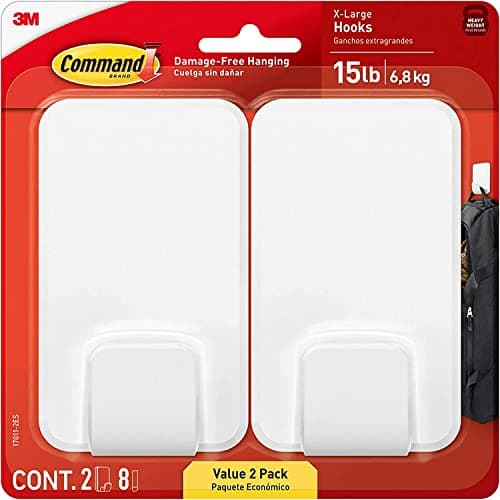
Command X-Large Utility Hook (17011-2ES)
Command · Best for the heaviest single item a wall can take without a fixing
9.1
out of 10
15 lb on a single adhesive hook, double the jumbo, and the only one in the range whose listed surfaces include painted cinderblock and concrete.
| Specification | Published figure | Source |
|---|---|---|
| Rated load | Holds up to 15 lb per hook | Command X-Large Single Hook product listing (Target) |
| Surfaces | Painted walls, painted concrete cinder blocks and concrete surfaces | Command X-Large Single Hook product listing (Target) |
| Hook size | 1.75 L x 4.7 H x 2.69 W in | Command X-Large Single Hook product listing (Target) |
| Stated limits | Wait seven days after painting before use; do not hang over beds or on wallpaper | Command X-Large Single Hook product listing (Target) |
What the specification gets you
- 15 lb published is double the jumbo hook and the highest single-hook figure in the damage-free range
- Painted cinderblock and concrete appear in the listed surfaces, which almost nothing else in the category claims
- The hook body is deep enough for a bag strap or a coiled extension lead rather than just a loop of cord
What it does not cover
- Bigger hook, bigger visual footprint -- at 4.7 in tall it is a piece of hardware on the wall, not a discreet peg
- The 15 lb figure assumes a correctly prepared surface and a full seven-day paint cure, and neither is checkable by eye
- The maker explicitly rules out wallpaper and hanging above a bed, which removes two of the places renters most want to use it
Coming off the wall
Pull the tab slowly straight down the wall, stretching at least 12 inches until the strip releases. The listing carries the maker's own warning not to hang it over a bed, which is as much about what happens when adhesive fails as about how it holds.
Skip this if
Skip this on wallpaper, on a wall painted in the last week, or anywhere above where somebody sleeps -- all three are ruled out on the listing itself.
- Published load
- 9.5
- Fit range
- 8.5
- Reversibility
- 8.5
- Documentation
- 9.5
- Price-to-capability
- 8.5
#ad Price as of September 13, 2026. How we are funded
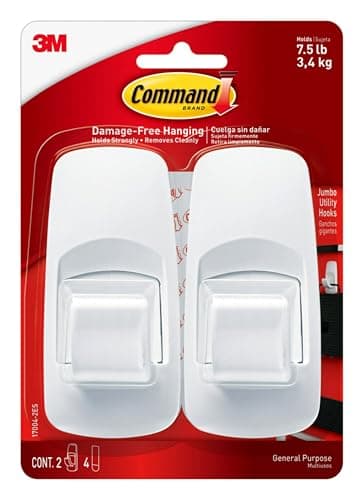
Command Jumbo Utility Hook (17004ES)
Command · Best for bike helmets, heavy winter coats, a loaded tote
9.3
out of 10
The heaviest published rating in the mainstream adhesive hook range: 7.5 lb, four strips, roughly 5 inches of hook. This is where damage-free hanging stops and drilling starts.
| Specification | Published figure | Source |
|---|---|---|
| Rated load | 7.5 lb | Command 17004ES product listing (Home Depot) |
| Supplied with | 1 hook, 4 large indoor strips | Command 17004ES product listing (Home Depot) |
| Hook height | 5 in | Command 17004ES product listing (Lowe's) |
| Surfaces | Smooth, solid, fully cured painted surfaces, finished wood, tile, metal. Not textured, wallpaper, brick, rough or non-stick surfaces, or fabric. | Command brand published surface guidance |
What the specification gets you
- 7.5 lb published, four strips of adhesive area -- the highest-rated mainstream option that still lifts off cleanly
- Physically large enough for a helmet strap or a coat collar rather than just a loop
- Cheap enough to use two side by side and split a load that neither would take alone
What it does not cover
- Big, white and visually obvious -- this is a utility hook, not a decorative one
- Four strips is four times the surface prep; one contaminated patch of wall drops the whole hook
Coming off the wall
Four strips, four tabs, pulled one at a time. This is the size where people get impatient and pull at an angle, which is how paint comes off.
Skip this if
Skip this if the wall is textured or the room steams. Neither is a rating problem -- the adhesive simply is not specified for either, so the 7.5 lb figure does not apply.
- Published load
- 10.0
- Fit range
- 7.5
- Reversibility
- 9.0
- Documentation
- 9.5
- Price-to-capability
- 9.0
#ad Price as of September 13, 2026. How we are funded
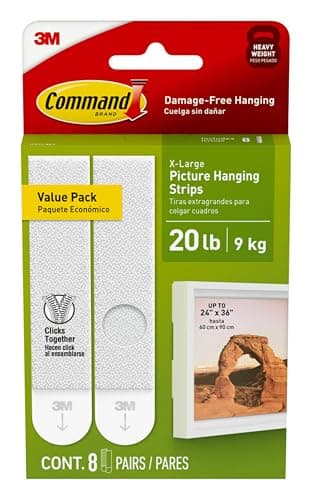
Command XL Heavyweight Picture Hanging Strips (17217-8ES)
Command · Best for full-length mirrors and large framed pieces
9.0
out of 10
20 lb published, which is the largest damage-free figure on this site and the only adhesive product here that will take a full-length mirror.
| Specification | Published figure | Source |
|---|---|---|
| Rated load | 20 lb | Command 17217-8ES product listing (Home Depot) |
| Supplied with | 8 pairs | Command 17217-8ES product listing (Home Depot) |
| Surfaces | Smooth, solid, fully cured painted surfaces. Not textured walls, wallpaper, brick or rough surfaces. | Command brand published surface guidance |
What the specification gets you
- The only published 20 lb damage-free figure in the mainstream range
- Spreads a heavy, wide object across eight pairs rather than concentrating it
- Turns a mirror -- normally the one item that forces a drill -- into a reversible decision
What it does not cover
- Surface prep is unforgiving at this weight: eight pairs means eight chances for one bad patch of wall
- Nothing published covers a mirror above a bed or a crib, and we are not going to pretend otherwise -- 20 lb of glass overhead is a judgment call the rating does not make for you
Coming off the wall
Every pair is a separate straight-down pull. On a 20 lb piece that is a two-person removal: one holding the mirror, one working the tabs.
Skip this if
Skip this on any wall that is textured, freshly painted, or papered. The 20 lb figure assumes a smooth, cured, solid surface, and outside that it means nothing.
- Published load
- 10.0
- Fit range
- 7.0
- Reversibility
- 8.0
- Documentation
- 8.5
- Price-to-capability
- 8.5
Spectrum Janisse Over-the-Door Wall Hook
Spectrum Diversified · Best for solid-core and 1-3/4 in doors
7.6
out of 10
The one that fits a thick door: it locks over doors from 1-7/16 to 2-1/4 in, which is the range where most over-door hardware quietly gives up.
| Specification | Published figure | Source |
|---|---|---|
| Door thickness | Locks into place over doors from 1-7/16 in to 2-1/4 in | Spectrum Janisse product listing |
| Mechanism | Adjusts when light pressure is applied, then locks | Spectrum Janisse product listing |
What the specification gets you
- Covers 1-3/4 in doors, which the Umbra and both Yamazaki racks do not
- The adjusting mechanism means one product spans a range instead of a single thickness
- Solves the most common over-door failure: the door is thicker than the hook
What it does not cover
- We could not find a published weight rating for this hook, so we are not quoting one -- and you should not assume the thick-door range implies a high load
- A hook, not a rack -- capacity is a couple of items, not a wardrobe
Coming off the wall
Lift off the door.
Skip this if
Skip this if your door is under 1-7/16 in. A hook designed to lock onto a thick door rattles loose on a hollow one.
- Published load
- 3.0
- Fit range
- 10.0
- Reversibility
- 10.0
- Documentation
- 6.0
- Price-to-capability
- 8.0
#ad Prices change; we show one only when our feed has a live figure. How we are funded
Questions people actually ask
Why do my Command hooks keep falling off?
Almost always one of five things: the hook was over its published rating, the surface is not one the maker specifies, the wall was cleaned with something other than rubbing alcohol, the load went on before the adhesive had an hour to set, or the paint was less than seven days old.
How do I make Command strips stick better?
Clean the surface with rubbing alcohol rather than a household spray, press the strip firmly for about 30 seconds, and leave the hook empty for at least an hour before hanging anything. For anything near the top of its rating, leave it overnight instead.
Why won't Command strips stick to my wall?
Check the surface against the published list. Textured paint is the usual culprit and it looks perfectly smooth from a distance -- adhesive only touches the high points, which is a fraction of the area the rating assumes. Wallpaper, brick and rough surfaces are ruled out too, and no rating is published for any of them.
Can I reuse a Command strip that fell off?
No. The strips are single-use. A released strip has picked up dust and lost the surface chemistry it needed, which is why the second attempt often fails faster than the first. Replacement strips are sold separately.
Will two hooks hold twice as much?
No. The load rarely divides evenly between two hooks, so one ends up over its published rating without any visible warning. If you need 15 lb, buy the hook rated for 15 lb.
How long should I wait after painting before using adhesive hooks?
Seven days is the published guidance. Uncured paint has not developed its full bond to the wall, so the adhesive can grip the paint harder than the paint grips the drywall -- and the hook comes down with a patch of color attached.
What holds more than an adhesive hook?
A set of XL picture hanging strips publishes 20 lb for a flat-backed object, and a single X-Large utility hook publishes 15 lb. Above that nothing in the damage-free category publishes a figure, and the mechanism has to change to an over-the-door hook or a freestanding unit.