Shelving · Comparison
Adhesive vs Tension vs Freestanding Shelving
Three mechanisms, three completely different capacity ceilings, and three different things they ask of your apartment.
By Scooter M. · Published · How we pick
Disclosure · We earn a commission on purchases made through the Amazon links on this page, at no extra cost to you. These picks come from published specifications, not from hands-on use. How this site is funded.
The short answer
Adhesive costs no floor space and publishes 2 to 5 lb, on smooth cured walls only. Tension needs two opposing surfaces to push against, and many products publish no load rating at all. Freestanding publishes 11 to 66 lb per shelf, works on any wall including textured and papered ones, and takes floor space. Pick by which of those three costs you can afford.
What each one is actually doing
Adhesive: a glue line resisting a cantilever
A strip bonds to the wall and the shelf sticks out from it. The weight tries to rotate the top edge of the strip off the surface -- peel, the weakest direction for adhesive -- and the deeper the shelf, the larger that rotating force is for the same weight. That is the whole reason adhesive shelving is shallow and lightly rated, and why surface quality decides everything: on textured paint or wallpaper the published figure does not apply at all.
Tension: friction between two surfaces
A spring or screw mechanism pushes outward against two opposing faces, and friction does the rest. It is genuinely elegant, it bonds to nothing, and it is the most reversible mechanism here. It is also the least documented: several tension products we looked at publish no load figure whatsoever, and the ones that do vary wildly -- from 2.33 lb to 22 lb on rods of similar appearance (see tension rod weight limits). Friction also depends on what it is pushing against, and a slick painted reveal or glossy tile is a worse case than bare drywall.
Freestanding: the load goes into the floor
No wall involvement at all. The published rating is limited by the shelf panel and the frame, which is why the figures are an order of magnitude higher. It is the only mechanism on this page that does not care what your walls are made of.
The comparison
| Adhesive | Tension | Freestanding | |
|---|---|---|---|
| Published load | 2-5 lb | Model-dependent; often not published | 11-66 lb per shelf |
| Needs from the room | A smooth, cured, solid wall | Two opposing surfaces at the right spacing | Floor space |
| Works on textured or papered walls | No | Yes -- it does not bond to anything | Yes |
| Leaves behind | Nothing, if removed correctly on a cured wall | Nothing; sometimes a burnished mark at the contact points | Nothing |
| Repositioning | Single-use strips; a reposition means new strips | Free -- release and move it | Free |
| Failure mode | Lets go, often taking paint if the surface was wrong | Slips or creeps down over time | Tips, if it is tall and unanchored |
| Best at | Display weight where no floor is available | Spanning an alcove, a shower, a closet | Actual storage |
Choosing, in one paragraph each
Choose adhesive when the object is light, the wall is smooth cured paint, and floor space is genuinely unavailable -- a hallway, beside a bed, above a desk. Accept that this is display capacity. Read the surface matrix before you buy, because it will tell you in thirty seconds whether your walls disqualify the whole approach.
Choose tension when you have two surfaces at a fixed spacing that you want to span -- an alcove, a window reveal, a closet, a shower. It is the right mechanism for rods and caddies more often than for shelves, which is why most of our tension coverage lives in windows and shower caddies. Check for a published load and be skeptical if there is not one.
Choose freestanding whenever the shelf has to hold anything real. It is the correct answer more often than renters expect, and it is completely immune to the two things that break the other options: your wall surface and your landlord. The picks are in best no-drill shelves.
What to buy for this
Picked from the same registry as our roundups, on published specification. Nothing here has been tested by us, and we say so on every page.
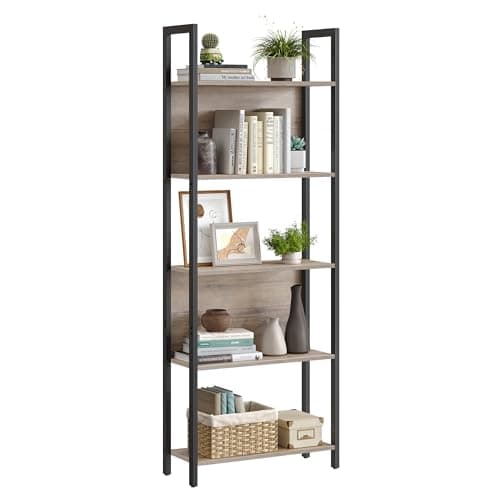
VASAGLE 5-Tier Bookshelf (ULLS025B02)
VASAGLE · Best for books, kitchen storage, anything genuinely heavy
9.2
out of 10
44 lb per shelf published. That is the number that ends the no-drill shelving argument: nothing adhesive is within an order of magnitude of it.
| Specification | Published figure | Source |
|---|---|---|
| Rated load | 44 lb (20 kg) static load per shelf | VASAGLE ULLS025B02 product listing |
| Configuration | 5 tiers, freestanding | VASAGLE ULLS025B02 product listing |
What the specification gets you
- 44 lb per shelf, published, against 2 to 5 lb for every adhesive shelf we could find a rating for
- Five shelves at that rating is more usable capacity than a renter can normally get without a drill
- Nothing touches the wall, so nothing on the walk-through inspection touches you
What it does not cover
- Freestanding tall furniture wants an anti-tip fixing, and an anti-tip fixing is a hole -- the honest tension in the whole category
- Floor footprint is real; in a small apartment that is the trade you are actually making
Coming off the wall
It is furniture. Pick it up and take it with you.
Skip this if
Skip this if floor space is what you are short of. A leaning ladder unit gives up capacity for a smaller footprint, and adhesive ledges give up almost all of it for none.
- Published load
- 10.0
- Fit range
- 7.5
- Reversibility
- 10.0
- Documentation
- 8.5
- Price-to-capability
- 9.0
#ad Price as of October 17, 2026. How we are funded
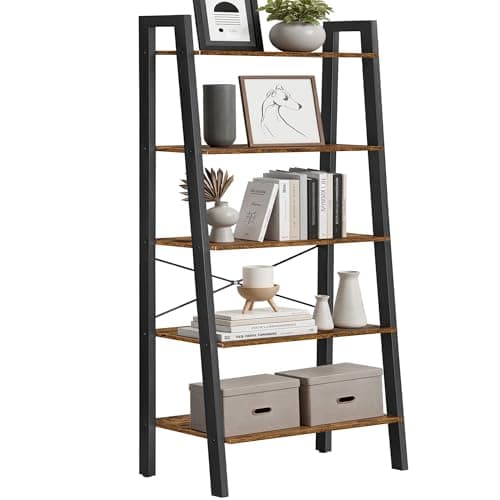
VASAGLE Leaning Ladder Shelf, 5-Tier (ULLS46BX)
VASAGLE · Best for a wall of storage in a rental with zero fixings
8.8
out of 10
11 lb per tier published, and it leans rather than mounts -- the storage answer for a wall you are not allowed to touch.
| Specification | Published figure | Source |
|---|---|---|
| Rated load | 11 lb (5 kg) static load per shelf | VASAGLE ULLS46BX product listing |
| Configuration | 5 tiers, leaning against the wall | VASAGLE ULLS46BX product listing |
What the specification gets you
- 11 lb per tier is more than double the best adhesive shelf on this site, published, per shelf
- Five tiers of storage on a wall that has no holes in it and never will
- Leaning geometry means the footprint is small even though the storage is not
What it does not cover
- It leans, so it takes floor space -- in a studio that is the scarce resource, not wall space
- 11 lb per tier is a static figure; a leaning unit is easier to knock than a bolted one, which the rating does not describe
Coming off the wall
Lift it away. It touches the wall as a lean, not a fixing, so there is nothing to remove and nothing to patch -- though the top rail can mark paint if it is dragged.
Skip this if
Skip this if you have children or a cat with ambitions. A leaning unit is not anchored, and nothing in the specification pretends it is.
- Published load
- 8.5
- Fit range
- 8.0
- Reversibility
- 10.0
- Documentation
- 8.5
- Price-to-capability
- 8.5
Command Picture Ledge
Command · Best for leaning frames and light objects on a wall that cannot be drilled
8.2
out of 10
5 lb is the highest published figure we found for an adhesive ledge, and it is still a ledge: photographs, a small plant, a phone -- not books.
| Specification | Published figure | Source |
|---|---|---|
| Rated load | 5 lb | Command Picture Ledge product listing (Walmart) |
| Supplied with | 1 ledge, 10 strips | Command Picture Ledge product listing (Walmart) |
What the specification gets you
- 5 lb published, which is double the Command Display Ledges at 2 lb
- A ledge holds leaning objects, so the load sits down into the shelf rather than pulling out from the wall -- the direction adhesive handles best
- Ten strips spread the load along the full length instead of at two ends
What it does not cover
- 5 lb is roughly four hardback books; a row of paperbacks will exceed it
- Depth is display depth, not storage depth -- anything that needs to sit fully on the shelf will overhang
Coming off the wall
Strip tabs pull straight down, one at a time, after the ledge is cleared.
Skip this if
Skip this if you want a shelf rather than a display surface. A freestanding unit publishes 11 to 66 lb per shelf and touches your walls nowhere at all.
- Published load
- 6.5
- Fit range
- 7.5
- Reversibility
- 9.5
- Documentation
- 7.5
- Price-to-capability
- 8.5
#ad Prices change; we show one only when our feed has a live figure. How we are funded
Questions people actually ask
Which no-drill shelving holds the most weight?
Freestanding, by a wide margin: 11 to 66 lb per shelf published, against 2 to 5 lb for adhesive. It also works on any wall, because it does not touch one.
Are tension shelves any good?
The mechanism is sound and it is the most reversible of the three, but the documentation is poor -- several tension products publish no load rating at all. It suits spanning a fixed gap (an alcove, a shower, a closet) better than free-form shelving.
Will a tension system damage the surfaces it pushes against?
Usually not, though rubber feet under sustained compression can leave a burnished ring on painted surfaces, which normally wipes off. It bonds to nothing, so there is no adhesive residue and no paint to lift.
Can I use adhesive shelving on a textured wall?
No. Adhesive needs full contact and a textured surface only gives it the high points, which is why the manufacturer advises against it and publishes no rating for that case. Freestanding is the answer on textured walls.
Which is best for a rental I am leaving in a year?
Freestanding: it comes with you, leaves nothing, and cannot damage anything on the way out. The only caveat is the anti-tip strap on tall units, which is a fixing worth discussing with your landlord.