Renter-Friendly · Playbook
Small-Apartment Storage: A Room-by-Room System
Six rooms, one rule -- use the floor and the doors before you use the walls.
By Scooter M. · Published · How we pick
Disclosure · We earn a commission on purchases made through the Amazon links on this page, at no extra cost to you. These picks come from published specifications, not from hands-on use. How this site is funded.
The short answer
Work room by room in this order: entryway, living, bedroom, closet, kitchen, bathroom. In each one, exhaust the floor and the doors before touching a wall -- that is descending order of published capacity and ascending order of risk to your deposit.
A small apartment is not short of storage so much as short of divided space: tall cabinets holding one layer of plates, a closet with one rail and three feet of air under the shirts, a corner nobody uses. Most of this plan is about dividing volume rather than acquiring more of it.
Entryway
The highest-traffic square yard in the apartment, and usually the least planned. What it needs is somewhere for keys, somewhere for the daily bag, and somewhere for shoes that is not the floor.
- Keys and the daily layer: an adhesive hook rated 3 lb for keys and a 5 lb one for a bag, if the wall is smooth and cured. If it is textured, an over-door hook on the entry door does the same job with no wall involved.
- Shoes: a narrow freestanding unit, not a wall rack. 11 lb per tier published, and shoes are heavier and dirtier than wall-mounted storage wants.
- Coats: if you are hanging more than two, this is a floor problem rather than a wall problem -- adhesive tops out at 7.5 lb per hook and a wet winter coat eats most of that.
The bike, if there is one
A bike in a hallway is the single largest loose object in most small apartments, and the racks sold for it nearly all need a stud and a drill. The no-drill options -- floor cradles, leaning gravity stands and floor-to-ceiling columns -- publish per-bike figures from 30 lb to 75 lb, and best renter-friendly bike storage ranks them on that number and on whether you have to lift the bike to use them.
Living room
The room where the corner is the opportunity. Freestanding shelving publishes 11 to 66 lb per shelf and a corner unit uses the floor nobody spends. If the walls are smooth and cured, this is also the room where picture hanging strips earn their place -- 20 lb published for an XL set, which covers most framed art and a full-length mirror.
Windows come next, and the decision is made by the trim rather than by you -- tension rod vs curtain rod.
Bedroom
- Under the bed is the largest single volume in most bedrooms. Flat containers on the floor, no fixings, nothing to explain at move-out -- measure the clearance under the frame first, because it decides everything (the under-bed roundup).
- The back of the door takes an over-door rack at up to 5 lb per hook -- measure the edge first (door thickness and fit).
- Beside the bed, where there is no room for a table: an adhesive ledge at 5 lb published holds a phone, a book and a glass, and costs no floor at all.
Closet
The highest-value fix in the apartment is a second rail: a tension rod below the existing one doubles hanging capacity for short items, and it lifts out at move-out. If the apartment is a single room rather than a set of them, start with studio apartment setup, which divides before it stores. Full plan, including the door and the shelf above the rail, in apartment closet organization. When the closet is too small to rescue, the no-drill closet systems roundup ranks rod doublers, hanging shelf towers and freestanding racks on published load.
Kitchen
Everything inside the cabinets, nothing fixed to them: risers to divide tall shelves, tension rods set vertically to separate trays and lids, an expandable rack under the sink that clears the trap, containers rather than fitted dividers. The full version is renter-friendly kitchen cabinet organization, the ranked risers and baskets are in best kitchen cabinet organizers, and the measuring method is under-sink clearance.
Bathroom
Under the sink first, then the shower floor, then the walls -- and in the shower, prefer anything that is not glue. A freestanding caddy publishes 13.2 lb and a tension pole touches nothing; humidity is why. Towels go on the back of the door rather than on adhesive, because wet cotton is heavy and stays wet.
| Room | First move | Published figure | Fixings |
|---|---|---|---|
| Entryway | Freestanding shoe unit + one hook | 11 lb per tier; 3-5 lb per hook | None |
| Living | Corner freestanding unit | 11 lb per tier | None |
| Living | Picture strips for art and mirrors | 15-20 lb per set | None |
| Bedroom | Under-bed containers + over-door rack | Up to 5 lb per hook | None |
| Closet | Tension rod as a second rail | 2.33-22 lb by model | None |
| Kitchen | Risers, rods, under-sink rack | 2.33 lb rod; racks unpublished | None |
| Bathroom | Under-sink rack, then a freestanding caddy | 13.2 lb caddy | None |
What not to do in a small apartment
- Do not buy storage before measuring. Fit rejects more purchases than load does, in every room.
- Do not put deep shelves in a walkway. Roughly 30 inches of clear passage keeps a hallway comfortable (shelf depth and clearance).
- Do not use adhesive on textured or papered walls. No published rating applies, and the failure costs paint.
- Do not fill the top shelf with loose items. If it takes two hands and a chair, it will not get put back.
- Do not forget the laundry corner. A gap cart or a frame that stands over the machines adds storage with no fixings at all (laundry room storage).
What to buy for this
Picked from the same registry as our roundups, on published specification. Nothing here has been tested by us, and we say so on every page.
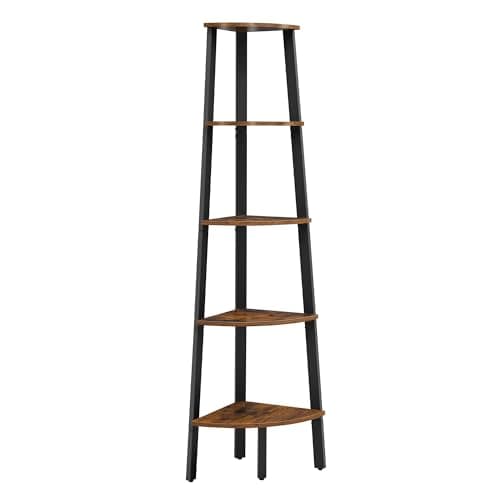
VASAGLE 5-Tier Corner Ladder Shelf
VASAGLE · Best for dead corners in small rooms
8.5
out of 10
11 lb per tier in the one part of a rental nobody else uses: the corner. Zero wall contact, zero holes, and it fits where a rectangle will not.
| Specification | Published figure | Source |
|---|---|---|
| Rated load | 11 lb load capacity per tier | VASAGLE corner ladder shelf product listing (Walmart) |
| Configuration | 5 tiers, corner footprint, freestanding | VASAGLE corner ladder shelf product listing (Walmart) |
What the specification gets you
- Uses a corner, which is the square footage renters never manage to spend
- 11 lb per tier published, against 2 to 5 lb for anything adhesive
- Tall and narrow, so the storage is vertical where small apartments have room
What it does not cover
- Corner shelves are shallow at the front edge, so wide objects overhang
- Same anti-tip tension as any tall freestanding unit
Coming off the wall
Freestanding furniture. Lift and go.
Skip this if
Skip this if your corner is where the radiator, the door swing or the window falls -- measure the arc of the door before you buy anything corner-shaped.
- Published load
- 8.5
- Fit range
- 8.5
- Reversibility
- 10.0
- Documentation
- 7.5
- Price-to-capability
- 8.5
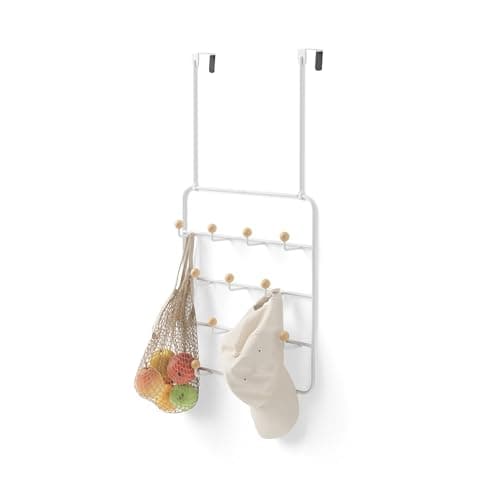
Umbra Estique Over-the-Door Organizer
Umbra · Best for a bedroom or bathroom door doing the work of a closet
9.3
out of 10
5 lb per hook across 14 hooks, and Umbra publishes the door thickness it fits. Both numbers, from the manufacturer, which is the whole reason it wins here.
| Specification | Published figure | Source |
|---|---|---|
| Rated load | Maximum 5 lb (2.3 kg) per hook | Umbra published product page (manufacturer) |
| Door thickness | Fits doors up to 1.5 in (3.8 cm); up to 1.6 in (4 cm) with the attachable hooks | Umbra published product page (manufacturer) |
| Dimensions | 14.25 x 4.25 x 23.75 in (36 x 11 x 60 cm) | Umbra published product page (manufacturer) |
| Hooks | 14, powder-coated steel frame with wooden pegs | Umbra published product page (manufacturer) |
What the specification gets you
- 5 lb per hook is the highest published per-hook figure we found in this category, by a wide margin
- 14 hooks at that rating is 70 lb of published capacity spread over a door that has none of it drilled
- Umbra publishes the door thickness, the per-hook load and the dimensions -- three numbers, all findable
What it does not cover
- 1.5 in is a real limit: a 1-3/4 in solid door is outside it unless you use the attachable hooks
- Wooden pegs are kinder to knitwear than bare steel, but they also reduce how much a hook can grip a thin loop
Coming off the wall
Lift it off the door. Nothing is fixed to anything.
Skip this if
Skip this if your door is 1-3/4 in thick, which many solid-core and bathroom doors are. Measure the door edge first -- it is a ten-second measurement that decides the purchase.
- Published load
- 10.0
- Fit range
- 7.0
- Reversibility
- 10.0
- Documentation
- 10.0
- Price-to-capability
- 8.5
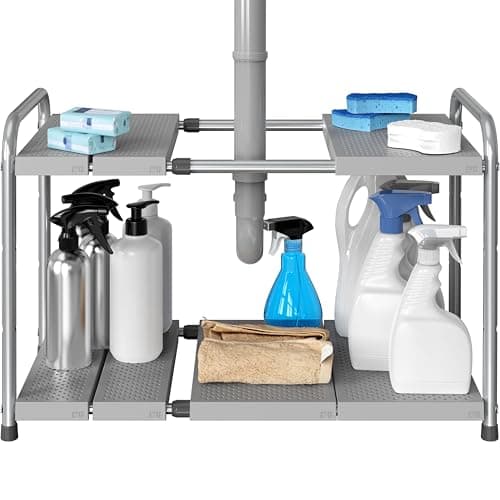
Simple Houseware Under-Sink 2-Tier Expandable Rack
Simple Houseware · Best for a cabinet whose plumbing sits off-center
8.5
out of 10
Adjustable 15.75 to 25 in wide with four shelf height levels, which is the specification that decides whether it clears your drain trap.
| Specification | Published figure | Source |
|---|---|---|
| Adjustable width | 15.75 to 25 in | Simple Houseware product listing |
| Height adjustment | 4 shelf height levels | Simple Houseware product listing |
| Dimensions | 11.75 D x 25 W x 15.25 H in at full extension | Simple Houseware product listing |
| Rated load | Not published for this model, so we are not quoting one. | Simple Houseware product listing |
What the specification gets you
- Four height levels is the feature that matters -- a drain trap sits at a different height in every apartment
- Width adjusts across a 9 in range, which covers most single-door and many double-door cabinets
- Nothing attaches to the cabinet, which is the point in a rental kitchen
What it does not cover
- No published weight rating, which for a shelf holding bottles of liquid is a genuine gap
- The 11.75 in depth assumes the cabinet is that deep behind the door frame -- measure past the hinge
Coming off the wall
It is a free-standing rack inside a cabinet. Lift it out.
Skip this if
Skip this if your trap sits dead center and low. A two-tier rack needs one clear side; a U-shaped single-tier organizer is the shape for a central obstruction.
- Published load
- 3.5
- Fit range
- 9.5
- Reversibility
- 10.0
- Documentation
- 7.0
- Price-to-capability
- 9.0
#ad Price as of October 17, 2026. How we are funded
Questions people actually ask
How do I add storage to a small apartment without drilling?
Work room by room and exhaust the floor and the doors before the walls: freestanding units at 11 to 66 lb per shelf, over-door racks at up to 5 lb per hook, tension rods spanning gaps, and only then adhesive on smooth cured walls.
What is the single best change in a rental?
A tension rod as a second rail in the closet. It roughly doubles hanging space for shirts, costs very little, takes ten minutes and leaves nothing behind.
Where is the unused space in a small apartment?
Under the bed, under the sink, the corner of the living room, the air above stacks inside tall cabinets, and the back of every hinged door. All of them are free to use and none needs a fixing.
How much walking space should I leave?
About 30 inches of clear width keeps a hallway or a route past furniture comfortable. Below roughly 24 inches it starts to feel like squeezing past things.
What should not go on the walls?
Anything heavy, anything on textured or papered walls, and anything in the shower. Adhesive publishes 7.5 lb per hook and 20 lb for picture strips on smooth cured surfaces -- outside that, use the floor or a door.