Windows · Comparison
Tension Rod vs Curtain Rod
One goes inside the window and one goes outside it, and that single difference decides light, width and what you can hang.
By Scooter M. · Published · How we pick

Disclosure · We earn a commission on purchases made through the Amazon links on this page, at no extra cost to you. These picks come from published specifications, not from hands-on use. How this site is funded.
The short answer
A tension rod mounts inside the window reveal, needs no trim and no hardware, and publishes anywhere from 2.33 to 22 lb depending on the model -- but the curtain can never be wider than the window. A no-drill curtain rod on brackets mounts outside the opening on wooden trim, publishes 20 lb, hangs wider and higher, and requires trim between 1/2 and 1 inch wide.
Side by side
| Tension rod | Rod on no-drill brackets | |
|---|---|---|
| Published load | 2.33 to 22 lb, model-dependent | 20 lb (10 or 20 lb per center support) |
| Mounts | Inside the reveal, by friction | Outside the opening, tapped into wooden trim |
| Window requirement | Two sound opposing surfaces | Wooden casing 1/2 to 1 in wide |
| Excluded windows | Openings with no reveal depth | Oak, PVC, MDF, crown molding, metal trim |
| Curtain width | Limited to the opening | Can overhang the frame on both sides |
| Height | Inside the opening only | Above the opening, making the window read taller |
| Light leak at the edges | Yes, inherent to inside mount | Much less -- the panel overhangs |
| Leaves behind | Nothing; sometimes a burnished mark at the feet | Small pin marks in the top edge of the casing |
| Failure mode | Creeps, then slips | Bracket not fully seated on unsuitable trim |
The light-leak difference is the real one
Everything above matters, but this is the one people feel every morning. An inside-mounted rod puts the curtain inside the window opening, so light comes around all four edges no matter how good the fabric is. Outside mounting lets the panel overlap the frame, and the difference in a bedroom is the difference between a dark room and a dim one. If blackout is the point of the exercise, go and measure your trim before you buy a tension rod.
When tension is genuinely the better answer
- No trim at all. Plenty of modern apartments have drywall returns and no casing. Brackets have nothing to grip; tension does not need it.
- The trim is the wrong material. The bracket maker excludes oak, PVC, MDF, crown molding and metal by name.
- The curtain is light and the window is small. A cafe panel or a sheer over a kitchen window is exactly what a light tension rod is for.
- You want zero marks, anywhere. Tension bonds to nothing and taps into nothing.
- It is not a window at all. Closet rods, under-sink rods, shower rods -- tension is the whole mechanism, and the same sizing method applies (tension rod sizing).
When brackets win
- Blackout or lined curtains. 20 lb published, and the overhang the fabric needs to actually block light.
- Wide windows. With a center support, the span stops being the constraint; a tension rod at full extension is at its weakest.
- You want the window to look bigger. Mounting above the opening is available only to brackets.
- A rod that has already crept twice. If tension keeps slipping, the surface is telling you something -- a mechanically seated bracket is not subject to it.
And if you would rather have blinds
Blinds are the other half of this decision, with their own no-drill options and their own trade-offs against the drilled version -- no-drill vs drilled blinds. Whichever you choose, the installation order is the same and it is in how to hang curtains without drilling.
What to buy for this
Picked from the same registry as our roundups, on published specification. Nothing here has been tested by us, and we say so on every page.
Kwik-Hang Single Curtain Rod Bracket
Kwik-Hang · Best for wooden window trim, full-weight drapes
9.4
out of 10
20 lb published, and it holds by being tapped into the top of a wooden window casing -- not by sticking to the wall. The highest damage-free curtain figure on this site.
| Specification | Published figure | Source |
|---|---|---|
| Rated load | Up to 20 lb | Kwik-Hang published FAQ (manufacturer) |
| Trim it fits | Window trim at least 1/2 in wide, 1 in maximum | Kwik-Hang published FAQ (manufacturer) |
| Trim it does NOT fit | Hardwoods such as oak, PVC, crown molding, MDF, metal trim | Kwik-Hang published FAQ (manufacturer) |
| Projection | 3 in when installed | Kwik-Hang single bracket product page (manufacturer) |
| Installation | Positioned at the top corner of the window and tapped in with a hammer | Kwik-Hang published FAQ (manufacturer) |
What the specification gets you
- 20 lb is a real drapery figure -- blackout curtains and a metal rod, not just sheers
- The manufacturer publishes both what it fits and what it does not, which is rarer than it should be
- Removal is a lift, and the marks it leaves are on the top edge of the trim rather than the face of the wall
What it does not cover
- Needs wooden trim between 1/2 and 1 inch. A window with no casing, or a metal or MDF one, is simply out of scope
- It does put small pin marks into the trim -- damage-free here means no wall holes and no patching, not literally no mark
Coming off the wall
Manufacturer's own instruction: take off the rod and curtains, then lift the bracket up to disassemble. Reusable. It leaves the pin marks it made in the top edge of the casing, where the curtain hides them.
Skip this if
Skip this if your trim is MDF, PVC, metal, oak, or absent. The manufacturer says so itself, and a bracket that will not seat is a bracket that drops your curtains.
- Published load
- 10.0
- Fit range
- 6.5
- Reversibility
- 8.5
- Documentation
- 10.0
- Price-to-capability
- 9.0
#ad Prices change; we show one only when our feed has a live figure. How we are funded
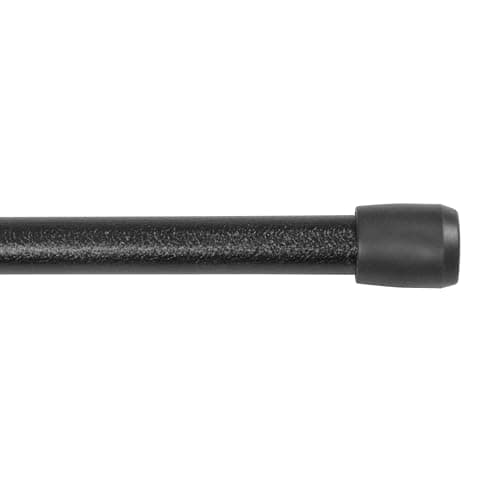
Kenney Strafford Spring Tension Rod (28-48 in)
Kenney · Best for inside-mount curtains on a 28-48 in opening
9.0
out of 10
22 lb published on a spring tension rod is an outlier figure, and it is the reason to read ratings per model rather than assume tension rods are all the same.
| Specification | Published figure | Source |
|---|---|---|
| Rated load | 22 lb maximum weight | Kenney Strafford product listing (Lowe's) |
| Span | Adjustable 28 to 48 in | Kenney Strafford product listing (Lowe's) |
What the specification gets you
- 22 lb published is far above the 2 to 7 lb figures on the light twist-and-fit rods
- Inside mount means no bracket, no trim requirement and no contact with the wall face at all
- The span range covers the standard bedroom window without a cut
What it does not cover
- A tension rod holds by friction against two surfaces, so a painted reveal that is slick or textured changes the outcome and no rating covers that
- Inside mount only -- it cannot hang wider than the opening, which is how you lose light control at the edges
Coming off the wall
Twist to shorten and lift out. On a painted reveal, the rubber end caps can leave a burnished ring where they have been under compression -- it usually wipes off.
Skip this if
Skip this if you need the curtain to overhang the window opening. Tension lives inside the reveal by definition; overhang needs a bracket.
- Published load
- 10.0
- Fit range
- 7.5
- Reversibility
- 9.5
- Documentation
- 8.0
- Price-to-capability
- 9.0
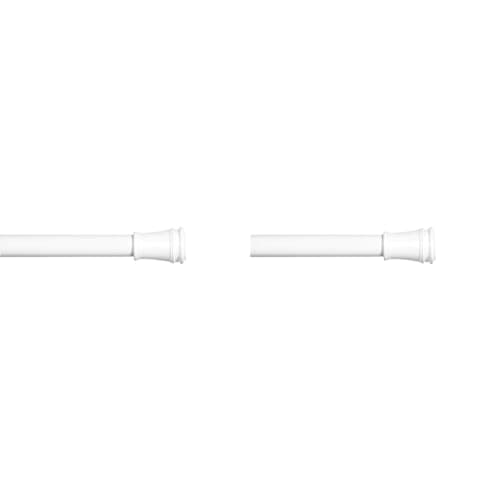
Kenney Rogers Twist & Fit No Tools Tension Rod
Kenney · Best for sheers, cafe curtains and light panels
7.9
out of 10
Published at a maximum recommended load of 4 lb on the 28-48 in size and 7 lb on the 48-84 in. Sheers and light panels -- and Kenney says so on the listing.
| Specification | Published figure | Source |
|---|---|---|
| Rated load | Maximum recommended load 4 lb (28-48 in); 7 lb (48-84 in) | Kenney KN634 product listing |
| Span | 28-48 in and 48-84 in versions | Kenney KN634 product listing |
| Diameter | 5/8 in | Kenney Rogers product listing (Walmart) |
What the specification gets you
- Publishes a maximum recommended load per length, which most tension rods do not
- The longer version is rated higher, which tells you the figure is about the rod and not just the mechanism
- No tools, no bracket, no trim requirement
What it does not cover
- 4 lb will not hold blackout drapes. The rating is not a formality here
- The longer the span, the more a mid-span load turns into deflection rather than grip
Coming off the wall
Twist to release tension, lift out. Nothing left behind on a sound painted reveal.
Skip this if
Skip this for lined or blackout curtains -- at 4 lb you are over the published figure before the second panel is on the rod. Use the 22 lb Strafford or a Kwik-Hang bracket.
- Published load
- 5.5
- Fit range
- 9.0
- Reversibility
- 9.5
- Documentation
- 9.0
- Price-to-capability
- 8.0
#ad Price as of October 17, 2026. How we are funded
Questions people actually ask
Is a tension rod or a curtain rod better for renters?
Whichever your window can take. Tension needs no trim and leaves nothing behind, but mounts inside the opening and leaks light at the edges. A bracket-mounted rod publishes more load, hangs wider and higher, but needs wooden trim between 1/2 and 1 inch wide.
Can a tension rod hold heavy curtains?
Only the higher-rated models. Published figures range from 2.33 lb to 22 lb across rods that look similar, so read the figure for the exact model before assuming.
Do tension rods leave marks?
Sometimes a burnished ring where the rubber feet have been under compression against paint, which usually wipes off. Nothing is bonded, so there is no adhesive residue.
Why does an inside-mounted curtain leak light?
Because the panel sits within the window opening, so light comes around all four edges regardless of the fabric. Outside mounting on brackets lets the curtain overlap the frame, which is what actually darkens a bedroom.
Can I mount a rod above the window without drilling?
Only with a bracket system on wooden trim -- a tension rod lives inside the opening by definition. Mounting above the opening is also what makes a window read taller.