Shelving · Guide
Shelf Depth and Clearance: Will It Fit?
Load gets the attention. Depth is what actually sends the shelf back.
By Scooter M. · Published · How we pick

Disclosure · We earn a commission on purchases made through the Amazon links on this page, at no extra cost to you. These picks come from published specifications, not from hands-on use. How this site is funded.
The short answer
Measure five things before buying any shelf: the depth you can give up, the door swing, the walkway left over, outlet and radiator clearance, and the depth of what actually goes on it. A hallway needs roughly 30 inches of clear walking width to stay comfortable, so a 12-inch-deep unit in a 36-inch hallway is a decision, not a detail.
The five measurements
1. Depth you can give up
Measure from the wall out to where the room needs to stay clear. That is your maximum shelf depth, and it is usually smaller than people expect once furniture, radiators and walking room are accounted for.
2. The door swing
Open every door near the wall in question, fully, and mark the arc. Doors swing further than the eye assumes, and a unit that fits the wall perfectly while the door is shut is a daily annoyance afterwards. The same applies to cabinet and closet doors near a freestanding unit.
3. What is left to walk through
In a hallway or beside a bed, subtract the shelf depth from the space and look at what remains. Comfortable passage is roughly 30 inches; below about 24 it starts to feel like squeezing past furniture, which is how a shelf ends up back in its box.
4. Outlets, radiators, vents and window trim
A shelf over an outlet blocks the plug. A shelf over a radiator bakes what is on it and disrupts the heat. A shelf that overlaps window trim will not sit flat against the wall at all, which matters for adhesive mounts especially -- the strip needs full contact on a single plane.
5. The depth of the objects
This is the one people skip. Measure the thing you are storing, not the category. Paperbacks are shallow, hardbacks and cookbooks are not, and a router or a speaker is usually deeper than the shelf someone bought for it. A shelf that everything overhangs is the wrong shelf.
Depths that suit what
| What it holds | Depth to look for | Why |
|---|---|---|
| Framed photos, a candle | Shallow display depth | Objects lean rather than sit fully on the shelf |
| Paperbacks | Enough for the book to sit fully on the shelf | Overhang is what makes a row of books fall forward |
| Hardbacks, cookbooks | Noticeably deeper than paperbacks | Cover boards are deeper than a paperback block |
| Kitchen storage, jars | Deeper still, and check height between tiers | Jar height decides tier spacing more than depth does |
| Electronics, a router | Measure the device | Devices are usually deeper than the shelf bought for them |
| Shoes | Deep enough that toes do not overhang | An overhanging shoe pushes the next pair off |
Corners: the space you already have
The one piece of floor a small apartment reliably wastes is the corner. A corner ladder unit takes 11 lb per tier into a footprint that was doing nothing, and its narrow front edge is the reason it feels smaller than a rectangular unit of the same capacity. The catch is that corner shelves are shallow at the front, so wide objects overhang. Measure the object, again.
Corners are also where fit stops being a straight measurement, because the two walls are rarely square to each other and almost nothing sold as a no-drill corner shelf publishes a load figure from an identifiable manufacturer. Best no-drill corner shelves covers the ones that do -- 11 lb per tier freestanding, 13.2 lb for a floor-standing caddy, 6.5 to 7.5 lb adhesive -- and says plainly why the rest are not ranked.
For wall-mounted shelves specifically
Depth is not only a room-planning question on a wall shelf -- it is a load question. The deeper the shelf, the greater the rotating force at the mount for the same weight, which is why adhesive shelving is always shallow and why a rating is not transferable between shelves of different depths. That mechanism is in how much weight a no-drill shelf really holds.
Once the fit is settled, the picks are in best no-drill shelves and the mounting method is in how to hang shelves without drilling. The same measure-first discipline applies to doors in door thickness and clearance and to cabinets in under-sink clearance.
What to buy for this
Picked from the same registry as our roundups, on published specification. Nothing here has been tested by us, and we say so on every page.
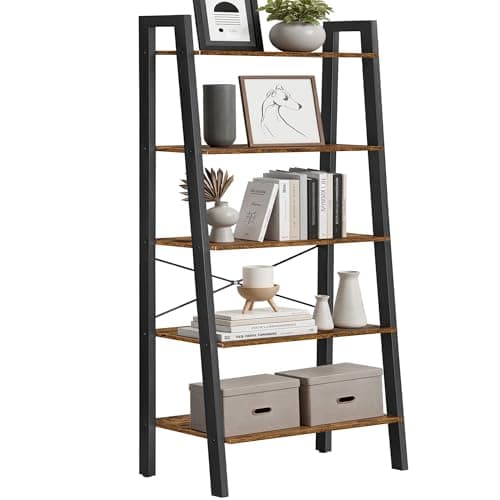
VASAGLE Leaning Ladder Shelf, 5-Tier (ULLS46BX)
VASAGLE · Best for a wall of storage in a rental with zero fixings
8.8
out of 10
11 lb per tier published, and it leans rather than mounts -- the storage answer for a wall you are not allowed to touch.
| Specification | Published figure | Source |
|---|---|---|
| Rated load | 11 lb (5 kg) static load per shelf | VASAGLE ULLS46BX product listing |
| Configuration | 5 tiers, leaning against the wall | VASAGLE ULLS46BX product listing |
What the specification gets you
- 11 lb per tier is more than double the best adhesive shelf on this site, published, per shelf
- Five tiers of storage on a wall that has no holes in it and never will
- Leaning geometry means the footprint is small even though the storage is not
What it does not cover
- It leans, so it takes floor space -- in a studio that is the scarce resource, not wall space
- 11 lb per tier is a static figure; a leaning unit is easier to knock than a bolted one, which the rating does not describe
Coming off the wall
Lift it away. It touches the wall as a lean, not a fixing, so there is nothing to remove and nothing to patch -- though the top rail can mark paint if it is dragged.
Skip this if
Skip this if you have children or a cat with ambitions. A leaning unit is not anchored, and nothing in the specification pretends it is.
- Published load
- 8.5
- Fit range
- 8.0
- Reversibility
- 10.0
- Documentation
- 8.5
- Price-to-capability
- 8.5
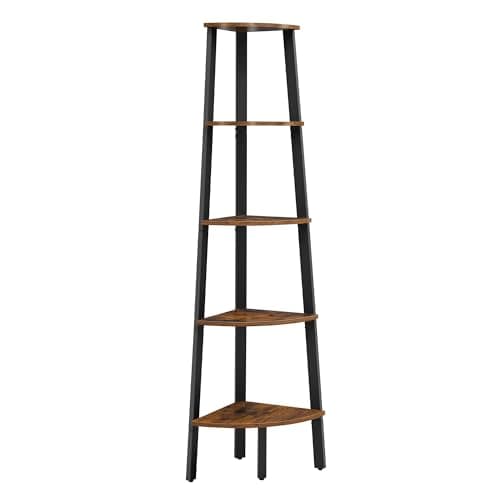
VASAGLE 5-Tier Corner Ladder Shelf
VASAGLE · Best for dead corners in small rooms
8.5
out of 10
11 lb per tier in the one part of a rental nobody else uses: the corner. Zero wall contact, zero holes, and it fits where a rectangle will not.
| Specification | Published figure | Source |
|---|---|---|
| Rated load | 11 lb load capacity per tier | VASAGLE corner ladder shelf product listing (Walmart) |
| Configuration | 5 tiers, corner footprint, freestanding | VASAGLE corner ladder shelf product listing (Walmart) |
What the specification gets you
- Uses a corner, which is the square footage renters never manage to spend
- 11 lb per tier published, against 2 to 5 lb for anything adhesive
- Tall and narrow, so the storage is vertical where small apartments have room
What it does not cover
- Corner shelves are shallow at the front edge, so wide objects overhang
- Same anti-tip tension as any tall freestanding unit
Coming off the wall
Freestanding furniture. Lift and go.
Skip this if
Skip this if your corner is where the radiator, the door swing or the window falls -- measure the arc of the door before you buy anything corner-shaped.
- Published load
- 8.5
- Fit range
- 8.5
- Reversibility
- 10.0
- Documentation
- 7.5
- Price-to-capability
- 8.5
Questions people actually ask
How deep should a shelf be?
Deep enough that what you are storing sits fully on it, and no deeper than the room can spare. Measure the objects rather than trusting a category: hardbacks, routers and shoes are all deeper than people estimate.
How much walking space do I need past a shelf?
Roughly 30 inches of clear width keeps a hallway comfortable. Below about 24 inches it reads as squeezing past furniture, which is usually when a unit gets returned.
Does shelf depth affect the weight it can hold?
On a wall-mounted shelf, yes. A deeper shelf multiplies the same weight into a larger rotating force at the mount, which is why adhesive shelving is always shallow and why load ratings do not transfer between different depths.
Can I put a shelf above a radiator?
It will interfere with the heat and cook whatever is on it. If it is the only wall available, keep it to items that do not mind warmth, and expect the room to heat less evenly.
What fits in a corner?
A corner ladder unit uses floor space that is otherwise wasted and publishes 11 lb per tier. Its front edge is shallow, so measure wide objects before assuming they will sit on it.