Hanging · Comparison
Adhesive Hooks vs Nails and Screws
The comparison an affiliate site is supposed to fudge. Sometimes the fastener is the right answer, and here is when.
By Scooter M. · Published · How we pick

Disclosure · We earn a commission on purchases made through the Amazon links on this page, at no extra cost to you. These picks come from published specifications, not from hands-on use. How this site is funded.
The short answer
Adhesive is the right answer up to its published ceiling -- 7.5 lb on a hook, 20 lb on a set of XL strips -- on smooth, cured, painted surfaces, and it leaves nothing to repair. A nail or screw wins the moment you need more than that, need it in a textured or papered wall, or need it to hold something you cannot afford to have fall. What it costs you is a hole, and the honest comparison is between two different repair jobs, not between damage and no damage.
Everything else on this site is about damage-free systems, so it would be easy to write this page as an advert for them. The problem is that it would be wrong, and you would find out at the moment your shelf came down. Here is the actual comparison.
Capacity is not close
| Adhesive | Nail in drywall | Screw into a stud | |
|---|---|---|---|
| Typical published ceiling | 7.5 lb hook / 20 lb strip set | Manufacturer-dependent; picture hooks are commonly rated in the 10-50 lb range | Far higher -- limited by the fastener and the framing, not the wall surface |
| Works on textured walls | No | Yes | Yes |
| Works on wallpaper | Not recommended | Yes, with a small puncture | Yes |
| Leaves behind | Nothing, on a cured painted wall removed correctly | A pin-sized hole | A hole plus, usually, an anchor |
| Repair at move-out | None, or a paint touch-up if it lifted | Filler, sand, touch-up | Filler, sand, touch-up; anchor removal can enlarge it |
| Reversible mid-tenancy | Yes, and it is designed to be | Yes, leaving the hole | Yes, leaving the hole |
When the fastener is simply the right answer
- Anything above 20 lb. There is no adhesive product on this site that covers it, and stacking hooks does not add their ratings together.
- Textured or papered walls. Adhesive is unrated there. A fastener does not care about surface texture at all.
- Anything overhead or above furniture people sit on. Published ratings describe static load on a prepared surface; they do not describe consequences.
- Anything that gets pulled on. A coat rack that takes a daily yank sees shock loads no static rating covers.
- Shelving that will hold books. Adhesive ledges publish 2 to 5 lb, and books are heavy. Either drill, or use a freestanding unit that publishes 11 to 66 lb per shelf.
What your lease actually says
Most standard residential leases are less absolute about small fixings than renters assume, and many landlords treat a filled nail hole as ordinary wear. Others do not, and some buildings prohibit fixings outright. That is a document question rather than a general one -- read the clause, and if it is ambiguous, ask in writing before you drill rather than after. We walk through the language to look for in can you drill in a rental.
The repair comparison nobody runs
The instinct is that a hole is damage and adhesive is not. In practice both can leave you with a repair, and the adhesive failure is often the larger one: a nail hole is a fill and a dab of touch-up, while a lifted patch of paint needs feathering and a color match that is frequently impossible on an aged wall, which pushes you toward repainting the whole wall. What decides it is not which method you chose but whether you used it correctly -- cured paint, right surface, slow straight removal. That is all in do adhesive hooks damage walls.
The rule we would actually give a friend
Under 20 lb, flat-backed, smooth cured wall: adhesive, every time, and it is genuinely the better answer. Over 20 lb, or textured, or papered, or overhead: either use a fastener with your landlord's blessing, or change the object -- a freestanding or tension system often does the same job while touching nothing. The ranked adhesive options are in best adhesive hooks for renters.
What to buy for this
Picked from the same registry as our roundups, on published specification. Nothing here has been tested by us, and we say so on every page.
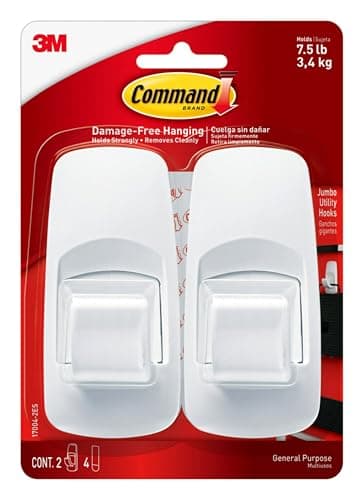
Command Jumbo Utility Hook (17004ES)
Command · Best for bike helmets, heavy winter coats, a loaded tote
9.3
out of 10
The heaviest published rating in the mainstream adhesive hook range: 7.5 lb, four strips, roughly 5 inches of hook. This is where damage-free hanging stops and drilling starts.
| Specification | Published figure | Source |
|---|---|---|
| Rated load | 7.5 lb | Command 17004ES product listing (Home Depot) |
| Supplied with | 1 hook, 4 large indoor strips | Command 17004ES product listing (Home Depot) |
| Hook height | 5 in | Command 17004ES product listing (Lowe's) |
| Surfaces | Smooth, solid, fully cured painted surfaces, finished wood, tile, metal. Not textured, wallpaper, brick, rough or non-stick surfaces, or fabric. | Command brand published surface guidance |
What the specification gets you
- 7.5 lb published, four strips of adhesive area -- the highest-rated mainstream option that still lifts off cleanly
- Physically large enough for a helmet strap or a coat collar rather than just a loop
- Cheap enough to use two side by side and split a load that neither would take alone
What it does not cover
- Big, white and visually obvious -- this is a utility hook, not a decorative one
- Four strips is four times the surface prep; one contaminated patch of wall drops the whole hook
Coming off the wall
Four strips, four tabs, pulled one at a time. This is the size where people get impatient and pull at an angle, which is how paint comes off.
Skip this if
Skip this if the wall is textured or the room steams. Neither is a rating problem -- the adhesive simply is not specified for either, so the 7.5 lb figure does not apply.
- Published load
- 10.0
- Fit range
- 7.5
- Reversibility
- 9.0
- Documentation
- 9.5
- Price-to-capability
- 9.0
#ad Price as of October 17, 2026. How we are funded
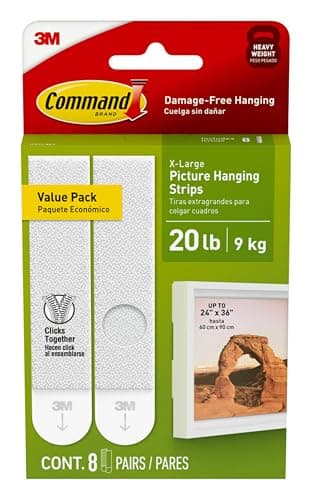
Command XL Heavyweight Picture Hanging Strips (17217-8ES)
Command · Best for full-length mirrors and large framed pieces
9.0
out of 10
20 lb published, which is the largest damage-free figure on this site and the only adhesive product here that will take a full-length mirror.
| Specification | Published figure | Source |
|---|---|---|
| Rated load | 20 lb | Command 17217-8ES product listing (Home Depot) |
| Supplied with | 8 pairs | Command 17217-8ES product listing (Home Depot) |
| Surfaces | Smooth, solid, fully cured painted surfaces. Not textured walls, wallpaper, brick or rough surfaces. | Command brand published surface guidance |
What the specification gets you
- The only published 20 lb damage-free figure in the mainstream range
- Spreads a heavy, wide object across eight pairs rather than concentrating it
- Turns a mirror -- normally the one item that forces a drill -- into a reversible decision
What it does not cover
- Surface prep is unforgiving at this weight: eight pairs means eight chances for one bad patch of wall
- Nothing published covers a mirror above a bed or a crib, and we are not going to pretend otherwise -- 20 lb of glass overhead is a judgment call the rating does not make for you
Coming off the wall
Every pair is a separate straight-down pull. On a 20 lb piece that is a two-person removal: one holding the mirror, one working the tabs.
Skip this if
Skip this on any wall that is textured, freshly painted, or papered. The 20 lb figure assumes a smooth, cured, solid surface, and outside that it means nothing.
- Published load
- 10.0
- Fit range
- 7.0
- Reversibility
- 8.0
- Documentation
- 8.5
- Price-to-capability
- 8.5
Questions people actually ask
Are adhesive hooks stronger than nails?
No. Adhesive tops out at 7.5 lb for a hook and 20 lb for a set of XL strips, while a fastener's capacity depends on the hanger and whether you reach framing, and generally exceeds both. Adhesive's advantage is that it leaves nothing behind, not that it holds more.
Will my landlord charge me for nail holes?
That depends on your lease and local norms. Many treat filled small holes as ordinary wear, some do not, and some buildings prohibit fixings entirely. Read the clause and get any permission in writing rather than assuming.
Is a lifted paint patch worse than a nail hole?
Often, yes, in terms of repair work: a nail hole is filled, sanded and touched up, while lifted paint needs feathered edges and a color match that frequently forces a full wall repaint.
When should a renter definitely use a screw instead?
Above 20 lb, on textured or papered walls where adhesive is unrated, for anything mounted overhead or above seating, and for anything that gets pulled on daily. Get permission first.
Can I use adhesive on a wall that already has holes?
Not over a patched area if you can avoid it. Filler and touch-up paint often bond less well than the original surface, so a strip stuck to a repair is more likely to bring the repair with it.