Hanging · Roundup
Mounting a TV Without Drilling
The heaviest thing a renter wants on a wall is the one thing damage-free hanging cannot do. The honest answer is a stand that puts the screen exactly where the mount would have.
By Scooter M. · Published · How we pick
Disclosure · We earn a commission on purchases made through the Amazon links on this page, at no extra cost to you. These picks come from published specifications, not from hands-on use. How this site is funded.
Quick picks
Ranked on published specification, not on hands-on use. Tap a row for the full write-up.
| # | Product | Best for | Score | Price |
|---|---|---|---|---|
| 1 | 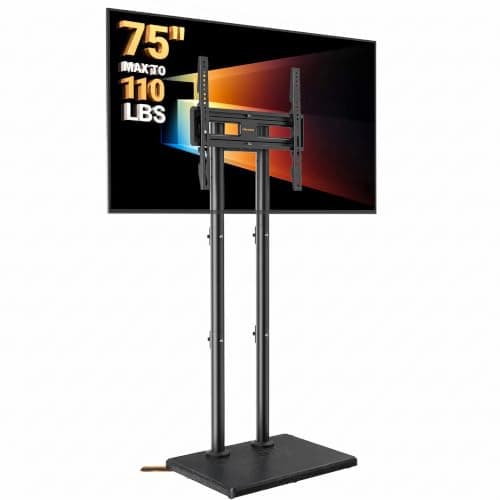 Perlegear Universal Floor TV Stand (PGFLS34B) Best overall: 110 lb, 32-75 in, nine published heights | Putting a 55 to 75 in TV at eye level with no fixings at all | 9.2out of 10 | |
| 2 | 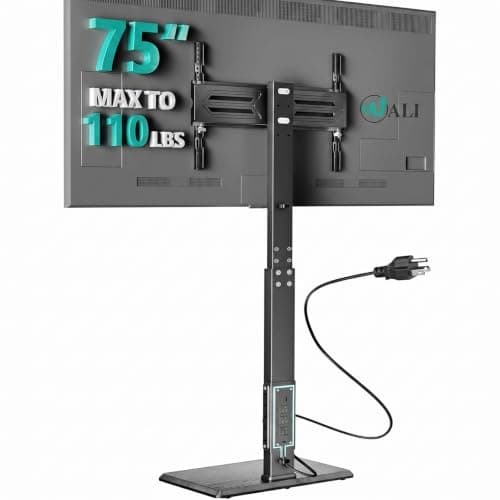 WALI Floor TV Stand with Power Outlet (TVDVD-7P) Best for a wall with no socket: 110 lb plus a built-in power hub | A TV wall with no socket behind it | 8.9out of 10 | |
| 3 | 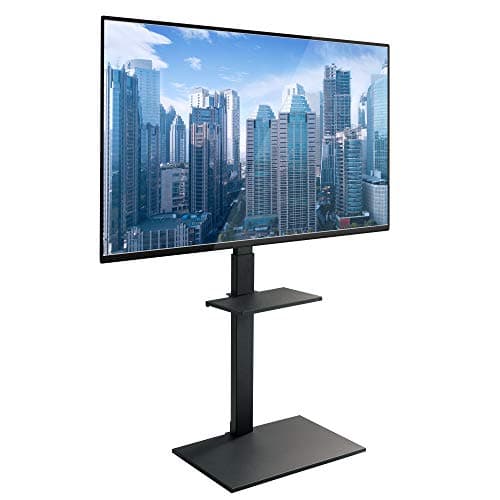 Mount-It! Tall TV Floor Stand with Shelf (MI-1877) Best for a small room: slim column, 12 in of height travel | A narrow wall or a corner in a small apartment | 8.8out of 10 | $137.99 · View on Amazon #ad Price as of October 17, 2026. How we are funded |
| 4 | 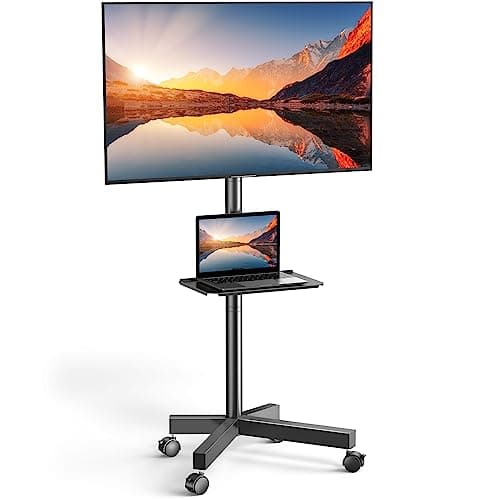 PERLESMITH Rolling TV Cart (PSTVMC04) Best if the TV has to move: 99 lb on locking casters | A studio or a room that has to be two rooms | 8.6out of 10 | $49.99 · View on Amazon #ad Price as of October 17, 2026. How we are funded |
| 5 | 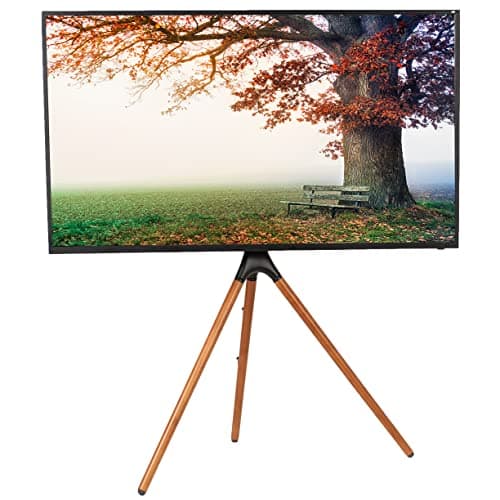 VIVO Easel TV Stand, 45-65 in (STAND-TV65A) Best looking: tripod easel, 77 lb, 90 degrees of swivel | A living room where the TV is on show and the walls are off limits | 8.5out of 10 | $89.99 · View on Amazon #ad Price as of October 17, 2026. How we are funded |
No. There is no adhesive, tension or magnetic product that will hold a television on a wall, and nothing on this site comes close -- the strongest damage-free strip we cover publishes 20 lb for eight pairs, and a 55 in TV weighs roughly double that. What works instead is a floor stand with the same mounting bracket a wall mount uses: the Perlegear PGFLS34B takes 32 to 75 in screens up to a published 110 lb and puts the panel at nine stated heights, with nothing touching the wall at all.
That is the verdict, and it is worth stating plainly because this is a question where the internet is full of improvisations that end with a cracked panel on a laminate floor.
The short answer
Why adhesive cannot do this, specifically
It is worth understanding the failure rather than just the number, because the same logic governs every heavy thing in a rental.
Adhesive strips are rated in shear -- load hanging straight down the face of the wall. Our weight limits table has the full published ladder, and the top of it is 7.5 lb for a single hook and 20 lb for a set of eight XL picture strips. Those figures assume a flat back against a smooth, clean, fully-cured painted surface.
A TV mount does something different. It holds the panel out from the wall, so the load tries to peel the top edge of the bond away rather than slide it down. Peel is the weakest direction any adhesive has, which is the same mechanism that limits adhesive shelves to 2 to 5 lb while a floor-standing unit publishes 44 lb a shelf -- the full version is in adhesive vs tension vs freestanding.
So the question is not whether a 20 lb product can hold a 40 lb TV. It is that a 20 lb shear rating tells you almost nothing about a cantilevered load, and the manufacturer publishes no figure for the way you would be using it.
How we judged the stands
Every product here publishes the same three figures a wall mount publishes, which makes them directly comparable with the mount you are not allowed to fit.
1. Published TV weight. The figure to check against your own set, which is printed in its manual. The range here is 77 to 110 lb.
2. Published VESA pattern. The hole spacing on the back of the TV in millimeters. Most 32 to 55 in sets are 200x200 or 400x400; large panels can be 600x400. Two stands here stop at 400x400 and two reach 600x400, and this is the figure that makes a stand simply not fit.
3. Published height range. The thing a floor stand gives you that a wall mount does not, because the bracket position is adjustable rather than drilled once.
4. What it costs the room. Floor space, which is the honest downside of every product here and the reason people wanted a wall mount in the first place.
| Stand | Published TV weight | Screen range | VESA published | Height published |
|---|---|---|---|---|
| Perlegear PGFLS34B | 110 lb | 32-75 in | 100x100 to 400x400 | 9 settings, 42.42-46.36 in |
| WALI TVDVD-7P | 110 lb | 32-75 in | 100x100 to 600x400 | 3 positions, no inches published |
| Mount-It! MI-1877 | 77 lb | 37-55 in | Up to 400x400 | 37-49 in |
| PERLESMITH PSTVMC04 cart | 99 lb | 23-65 in | 100x100 to 400x400 | Shelf 12-24 in; bracket adjustable |
| VIVO STAND-TV65A easel | 77 lb | 45-65 in | 200x200 to 600x400 | Adjustable, no figures published |
A floor stand is not a compromise on height
The usual objection to a stand is that the TV ends up lower than it would on a wall. The published figures say otherwise, if you pick the right one.
The recommended seated viewing height is eye level roughly at the center of the screen, which for most sofas puts the middle of the panel somewhere around 40 to 45 in from the floor. The Perlegear publishes nine settings from 42.42 to 46.36 in and the Mount-It! publishes 37 to 49 in -- both of which bracket that range, and the second of which is 12 in of travel against a wall mount's none.
The real differences are elsewhere. A wall mount costs no floor at all and a stand costs some. A stand swivels -- 20, 30 or 45 degrees depending on the model -- where a fixed wall mount does not. And a stand moves house with you, which after two rentals is not a small point.
The second renter problem nobody mentions
A wall-mounted TV needs its cables run inside the wall or hidden in a channel. A floor stand has the same problem in reverse: the cables now run down a column in the middle of the room rather than behind furniture.
Three of these address it with published detail. The Mount-It! routes cables inside the column rather than clipping them to it; WALI builds a power hub into the stand with three AC sockets and two USB ports on a 5.9 ft cord, so only one lead goes to the wall; and the PERLESMITH cart runs its wiring inside the metal column.
If your stand does not, the fix is the same one we cover for every trailing lead in a rental: cable clips, raceway and boxes, where the published adhesive figures and removal methods actually matter because that run is going on a wall or a baseboard you do not own.
Anti-tip, honestly
A 65 in panel on a single column is top-heavy by design. Every stand here addresses it and the approaches differ enough to matter.
Perlegear publishes a dual-column structure, a solid wood base, extended anti-tip feet and six non-slip pads -- and states that the extended feet are removable so the stand can sit closer to the wall. That is an honest trade, published: you can have the smaller footprint or the full stability, not both.
The rolling cart is the one to think hardest about. Locking casters are stated, and a locked caster is genuinely stable, but a cart is a thing that moves by design in an apartment where a toddler might lean on it. If there are small children, the weighted-base column stand is the better buy, and the same reasoning applies to the tall freestanding furniture in no-drill shelving.
What we would skip
Any adhesive, tension or magnetic solution, without exception. No product in any of those categories publishes a figure within sight of a television's weight, and the load direction is wrong as well as the magnitude.
A tension-pole stand braced floor to ceiling. These exist and they are sold for exactly this job. The problem is that a ceiling in a rented apartment is usually drywall on joists, the published tension figures are for the pole rather than for your ceiling, and the failure leaves a dent overhead that is far harder to explain than a screw hole.
A stand rated close to your TV's weight. Published capacity is a maximum under ideal assembly. A 60 lb TV on a 77 lb stand is fine; a 74 lb TV on the same stand is a decision made at the margin for no saving.
Buying before checking VESA. It is printed in your TV's manual and it is the one incompatibility that no amount of goodwill fixes.
The rest of the wall
Everything lighter than a TV has a damage-free answer, and the figures are the point: heavy-duty wall hooks covers what adhesive genuinely does hold, the weight limits table lists every published rating in one place, and the surface matrix covers the walls where even those figures do not apply.
The picks in full
Every figure below is published by the manufacturer or the retailer listing named beside it. Where a figure is not published, the row says so rather than carrying an estimate.
#1 · Best overall: 110 lb, 32-75 in, nine published heights
Perlegear Universal Floor TV Stand (PGFLS34B)
Perlegear · Best for putting a 55 to 75 in tv at eye level with no fixings at all
9.2
out of 10
Publishes the three figures a wall mount publishes -- screen range, weight and VESA -- and then adds the one a wall mount cannot: nine stated heights.
| Specification | Published figure | Source |
|---|---|---|
| Published TV weight | Up to 110 lb | Perlegear PGFLS34B product listing |
| Screen range published | 32 to 75 in, flat or curved | Perlegear PGFLS34B product listing |
| VESA published | 100x100 mm to 400x400 mm | Perlegear PGFLS34B product listing |
| Height adjustment | 9 stated settings from 42.42 to 46.36 in | Perlegear PGFLS34B product listing |
| Stability | Dual-column structure, solid wood base, extended anti-tip feet and six non-slip pads stated; the feet are stated to be removable to sit closer to the wall | Perlegear PGFLS34B product listing |
| Swivel | Plus or minus 20 degrees stated | Perlegear PGFLS34B product listing |
What the specification gets you
- 110 lb covers essentially every consumer TV up to 75 in
- Nine published heights, where a wall mount gives you one hole position and a drill
- The anti-tip feet are stated and removable, which is the honest trade between stability and footprint
What it does not cover
- The 42.42 to 46.36 in range is only 4 in of travel, all of it high -- this is a stand-and-watch height, not a low console height
- VESA stops at 400x400, so a few large panels will not match
- Those extended anti-tip feet are the reason it is stable and the reason it sticks out into the room
Coming off the wall
Nothing to remove. It stands on the floor and never touches the wall.
Skip this if
Skip this if you want the screen low, over a sideboard or at sofa-eye height. The published range starts at 42 in and goes up.
- Published figures
- 10.0
- Published load
- 10.0
- Adjustability
- 8.0
- Reversibility
- 10.0
- Value
- 9.0
#2 · Best for a wall with no socket: 110 lb plus a built-in power hub
WALI Floor TV Stand with Power Outlet (TVDVD-7P)
WALI · Best for a tv wall with no socket behind it
8.9
out of 10
The same 110 lb capacity with a wider VESA range, plus a built-in power hub that removes the second renter problem: the extension lead trailing across the floor.
| Specification | Published figure | Source |
|---|---|---|
| Published TV weight | Up to 110 lb | WALI TVDVD-7P product listing |
| Screen range published | 32 to 75 in | WALI TVDVD-7P product listing |
| VESA published | 100x100 mm to 600x400 mm -- the widest published pattern range in this group | WALI TVDVD-7P product listing |
| Power | Integrated outlet on the back with 3 AC sockets rated 125V/12A and 2 USB ports rated 5V/2.1A, on a stated 5.9 ft cord | WALI TVDVD-7P product listing |
| Adjustment | 3-position height adjustment for the support bar and bracket, a 2-position mounting panel, and 60 degrees of swivel (plus or minus 30) | WALI TVDVD-7P product listing |
What the specification gets you
- 600x400 VESA takes the large panels the 400x400 stands cannot
- The power hub is the detail that keeps a renter's cable run off the floor
- Plus or minus 30 degrees of swivel is the widest here outside the easel
What it does not cover
- Height adjusts in 3 steps rather than a continuous range, and no figures in inches are published for them
- The power hub is a real electrical item on a cheap stand, so it is the part to inspect on arrival
- No published base footprint, which is the figure a small room actually needs
Coming off the wall
Nothing to remove; it is furniture. The power hub unplugs from the wall socket you already have.
Skip this if
Skip this if there is a socket exactly where the TV goes. You are paying for a hub you will not use.
- Published figures
- 8.5
- Published load
- 10.0
- Adjustability
- 8.5
- Reversibility
- 10.0
- Value
- 9.0
#3 · Best for a small room: slim column, 12 in of height travel
Mount-It! Tall TV Floor Stand with Shelf (MI-1877)
Mount-It! · Best for a narrow wall or a corner in a small apartment
8.8
out of 10
The slim one, and the only stand here that publishes a load figure for its own shelf as well as for the TV.
| Specification | Published figure | Source |
|---|---|---|
| Published TV weight | Up to 77 lb | Mount-It! MI-1877 product listing |
| Screen range published | 37 to 55 in | Mount-It! MI-1877 product listing |
| Height adjustment | Stated 37 to 49 in -- 12 in of travel, the widest published range in this group | Mount-It! MI-1877 product listing |
| Shelf load published | 11 lb on the adjustable media shelf | Mount-It! MI-1877 product listing |
| Cables | Internal routing channels inside the column are stated, rather than external clips | Mount-It! MI-1877 product listing |
| Tilt and VESA | 10 degrees of anti-glare tilt; VESA up to 400x400 mm | Mount-It! MI-1877 product listing |
What the specification gets you
- 12 in of published height travel, which covers a sofa and a bed in one product
- Publishes the shelf's own load, which nothing else here does
- Cables run inside the column rather than cable-tied to it
What it does not cover
- 77 lb and 55 in is the lowest ceiling of the floor stands here
- The most expensive stand on this page
- No published base footprint
Coming off the wall
Nothing to remove. The listing sells it on exactly that -- no landlord, no move-out damage.
Skip this if
Skip this if your TV is 65 in or larger. The published screen range stops at 55 and the weight at 77 lb.
- Published figures
- 9.5
- Published load
- 7.5
- Adjustability
- 10.0
- Reversibility
- 10.0
- Value
- 7.0
#ad Price as of October 17, 2026. How we are funded
#4 · Best if the TV has to move: 99 lb on locking casters
PERLESMITH Rolling TV Cart (PSTVMC04)
PERLESMITH · Best for a studio or a room that has to be two rooms
8.6
out of 10
The one that moves. Locking casters and a published 99 lb capacity turn a TV into something you can roll out of the way of the thing you are not allowed to change.
| Specification | Published figure | Source |
|---|---|---|
| Published TV weight | Up to 99 lb | PERLESMITH PSTVMC04 product listing |
| Screen range published | 23 to 65 in, flat or curved | PERLESMITH PSTVMC04 product listing |
| Shelf height published | AV shelf adjustable from 12 to 24 in above the floor | PERLESMITH PSTVMC04 product listing |
| Tilt | 5 degrees down and 10 degrees up | PERLESMITH PSTVMC04 product listing |
| Wheels | Four casters with locking brakes stated, so it can be parked | PERLESMITH PSTVMC04 product listing |
| VESA published | 100x100 up to 400x400 mm | PERLESMITH PSTVMC04 product listing |
What the specification gets you
- Rolls, which no wall mount does and no fixed stand does
- 99 lb published, within 11 lb of the tall fixed stands
- The AV shelf height is published as a range rather than a single value
What it does not cover
- Wheels are the enemy of stability -- the lock is doing real work here
- Published screen range stops at 65 in
- No published base footprint, and a cart's footprint is what decides whether it fits beside a sofa
Coming off the wall
Roll it out of the room. Nothing is attached to anything.
Skip this if
Skip this if there are toddlers in the flat. A rolling 65 in screen with a brake is a worse proposition than a weighted base that cannot travel.
- Published figures
- 9.0
- Published load
- 9.0
- Adjustability
- 8.5
- Reversibility
- 10.0
- Value
- 9.5
#ad Price as of October 17, 2026. How we are funded
#5 · Best looking: tripod easel, 77 lb, 90 degrees of swivel
VIVO Easel TV Stand, 45-65 in (STAND-TV65A)
VIVO · Best for a living room where the tv is on show and the walls are off limits
8.5
out of 10
A tripod easel rather than a pole, which is the one no-drill TV answer that does not look like an admission of defeat -- at the cost of the largest floor footprint here.
| Specification | Published figure | Source |
|---|---|---|
| Published TV weight | Up to 77 lb | VIVO STAND-TV65A product listing |
| Screen range published | 45 to 65 in | VIVO STAND-TV65A product listing |
| VESA published | 200x200 mm up to 600x400 mm | VIVO STAND-TV65A product listing |
| Swivel | Plus or minus 45 degrees, the widest published swivel in this group | VIVO STAND-TV65A product listing |
| Structure | Tripod base in wood and steel, with height adjustment along the center pole | VIVO STAND-TV65A product listing |
What the specification gets you
- 600x400 VESA and 77 lb covers most 65 in panels
- 90 degrees of total swivel, which beats every pole stand here
- The only one that reads as a design object rather than a workaround
What it does not cover
- A tripod's legs claim more floor than a weighted column base
- No published height figures, only that the pole adjusts
- Starts at 45 in, so it is wrong for a bedroom TV
Coming off the wall
Nothing to remove. It is a tripod.
Skip this if
Skip this if floor space is the constraint. Three splayed legs in a small living room cost more than a column base does.
- Published figures
- 8.0
- Published load
- 7.5
- Adjustability
- 9.0
- Reversibility
- 10.0
- Value
- 7.5
#ad Price as of October 17, 2026. How we are funded
Questions people actually ask
Can you mount a TV without drilling into the wall?
Not onto the wall itself. No adhesive, tension or magnetic product publishes a figure anywhere near a television's weight -- the strongest damage-free strips we cover publish 20 lb for eight pairs, and a 55 in TV is roughly 35 to 45 lb. The working answer is a floor stand that takes the same VESA bracket a wall mount uses and publishes 77 to 110 lb, standing on the floor and touching nothing.
Will Command strips hold a TV?
No. The highest published Command figure on this site is 20 lb for a set of eight XL picture hanging strips, and that rating is for a flat-backed item resting against the wall. A TV mount holds the panel out from the wall, which loads the adhesive in peel rather than shear -- the weakest direction it has, and the direction no rating on the packet describes.
How much does a TV weigh?
Roughly 35 to 45 lb for a 55 in set and 50 to 65 lb for a 65 in one, though it varies by model and your own figure is printed in the manual. That is the number to check against a stand's published capacity. The stands here publish 77, 99 and 110 lb, so most sets sit comfortably inside them -- but check rather than assume, particularly on older or larger panels.
What is VESA, and why does it matter?
VESA is the spacing of the four mounting holes on the back of your television, given in millimeters -- 200x200 and 400x400 are the most common, and large panels can be 600x400. Every stand publishes the range it covers, and it is the one spec that cannot be worked around: a 600x400 TV will not fit a stand that stops at 400x400. Your figure is in the TV's manual.
Is a floor TV stand lower than a wall mount?
Not necessarily. The Perlegear publishes nine settings from 42.42 to 46.36 in and the Mount-It! publishes 37 to 49 in, which brackets the usual recommendation of having eye level near the middle of the screen from a sofa. What a stand genuinely costs you is floor space; what it gives back is adjustability, swivel, and a product that moves to the next flat with you.
Are rolling TV carts stable enough for a big TV?
The cart here publishes 99 lb and locking casters, and locked casters are genuinely stable on a flat floor. The question is not the rating but the household: a cart is designed to move, so in an apartment with small children a weighted-base column stand with anti-tip feet is the better choice. Where a cart earns its place is a studio or a room that has to serve two purposes, where the screen genuinely needs to move.
What about a tension pole TV mount braced floor to ceiling?
We would not. The published tension figures describe the pole, not your ceiling, and a rented ceiling is usually drywall fixed to joists that may not be where the pole lands. The failure mode is a dent or a crack overhead, which is harder and more expensive to put right than the screw holes you were trying to avoid in the first place.
Sources
- Perlegear Universal Floor TV Stand (PGFLS34B) -- listing publishes a 110 lb capacity, a 32 to 75 in screen range for flat or curved panels, VESA 100x100 to 400x400 mm, 9 height settings from 42.42 to 46.36 in, plus or minus 20 degrees of swivel, and a dual-column structure with a solid wood base, extended anti-tip feet and six non-slip pads; the extended feet are stated to be removable for a closer-to-wall position (product listing)
- WALI Floor TV Stand with Power Outlet (TVDVD-7P) -- listing publishes a 110 lb capacity, a 32 to 75 in screen range, mounting holes from 100x100 to 600x400 mm, an integrated power hub with 3 AC outlets rated 125V/12A and 2 USB ports rated 5V/2.1A on a 5.9 ft cord, a 3-position height adjustment and 60 degrees of swivel (product listing)
- Mount-It! Tall TV Floor Stand with Shelf (MI-1877) -- listing publishes a 77 lb capacity, a 37 to 55 in screen range, VESA up to 400x400 mm, height adjustment from 37 to 49 in, 10 degrees of anti-glare tilt, an 11 lb adjustable media shelf, and internal cable routing channels inside the column (product listing)
- PERLESMITH Rolling TV Cart (PSTVMC04) -- listing publishes a 99 lb capacity, a 23 to 65 in screen range, VESA 100x100 to 400x400 mm, an AV shelf adjustable from 12 to 24 in above the floor, 5 degrees of downward and 10 degrees of upward tilt, four casters with locking brakes and cable management inside the metal column (product listing)
- VIVO Easel TV Stand, 45-65 in (STAND-TV65A) -- listing publishes a 77 lb capacity, a 45 to 65 in screen range, VESA 200x200 to 600x400 mm, plus or minus 45 degrees of swivel, and height adjustment along the center pole on a wood and steel tripod base (product listing)