Windows · Comparison
Best No-Drill Blackout Blinds
Both of these publish 99 percent. That figure is about the fabric, and the light in your bedroom is coming from somewhere else.
By Scooter M. · Published · How we pick
Disclosure · We earn a commission on purchases made through the Amazon links on this page, at no extra cost to you. These picks come from published specifications, not from hands-on use. How this site is funded.
The short answer
Two no-drill shades publish 99 percent light blocking: a cellular fabric one and a paper one. Both figures are honest and both describe the fabric, not the window. Every shade here is an inside mount, and an inside mount leaves a gap at each side that no fabric percentage covers. If the requirement is a genuinely dark room, the shade is half the job and the edges are the other half.
This is the most oversold word in window coverings. Blackout gets used for anything darker than a net curtain, and buyers who want to sleep past sunrise end up disappointed by products that never claimed what they were bought for. The two products here do publish a number, which puts them ahead of most of the category -- and the number still does not mean what people read it to mean.
What 99 percent actually describes
It describes light passing through the material. Hold the fabric up and one percent of what hits it comes out the other side. That is a genuine and useful property, and it is why a blackout shade in a window looks like a dark rectangle rather than a gray one.
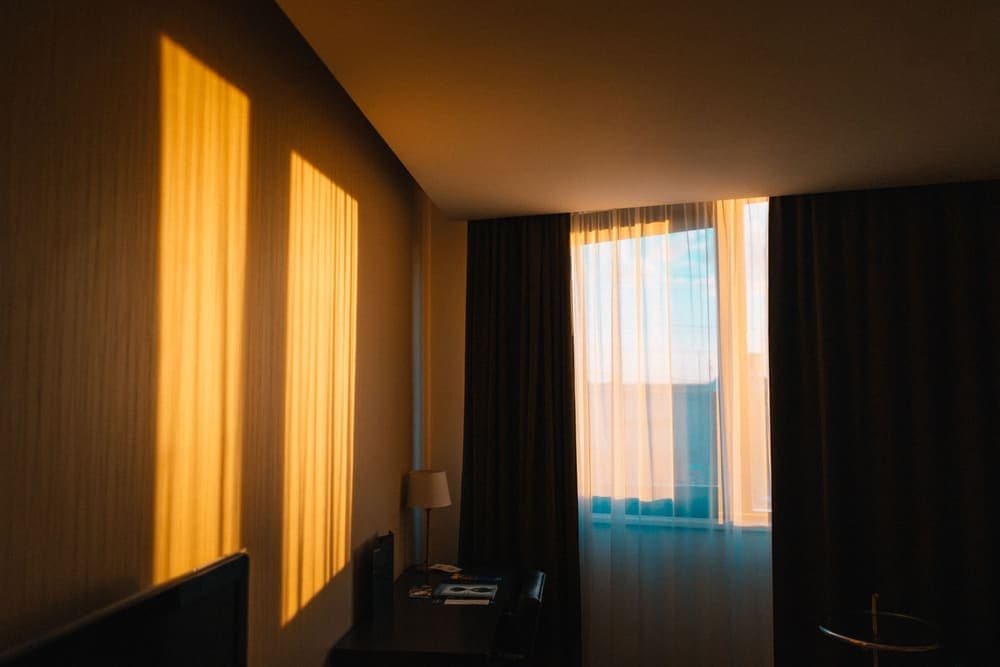
It says nothing about light passing around the material. An inside-mounted shade sits within the window opening, narrower than the opening by the clearance it needs to raise and lower. Along both vertical edges there is a gap. In a west-facing bedroom in June, that gap is a bright line up each side of the window and a wash of light across the ceiling, and it is entirely unaffected by whether the fabric blocks 99 percent or 100.
| Shade | Published figure | Material | Mounting |
|---|---|---|---|
| Easy Lift cellular blackout | Blocks up to 99% of all exterior light | 9/16 in honeycomb cellular fabric, cordless lift | Inside mount only; needs 1-1/4 in of depth |
| Original paper blackout | Block 99% of light | Paper, four shades per pack | Inside or outside the frame; peel and stick |
| Original paper room darkening | Block a majority of light -- no percentage published | Paper, four shades per pack | Inside or outside the frame; peel and stick |
Closing the gap, in order of cost
This is the part that actually determines whether the room gets dark, and none of it is exotic.
1. Mount outside the frame instead of inside
The paper shades publish that they can be trimmed for a fit inside or outside the window frame. Mounted outside -- on the flat wall or the face of the casing, overlapping the opening on both sides -- there is no side gap at all. It looks less tidy, it costs nothing extra, and it is by a wide margin the most effective thing on this list. The cellular fabric shade cannot do this: it is inside mount only.
2. Add a curtain over the shade
A curtain hung wider than the opening catches everything the shade misses, and the shade stops the curtain having to be blackout-lined. In a rental the hardware is the constraint, not the fabric: a no-drill bracket that taps into wooden trim publishes 20 lb, and a tension rod inside the reveal publishes up to 22 lb. Both are covered in best no-drill curtain rod brackets.
3. Two shades, side by side, overlapped
On a wide window, two narrower shades overlapping in the middle beat one wide one, because you can bias each toward its own edge. The paper shades come four to a pack, which makes this cheap enough to be worth doing.
4. Accept it and treat the ceiling
Most of what wakes people is not the bright line at the window edge, it is the light bouncing off a pale ceiling above it. A shade mounted as high as the reveal allows aims the leak downward rather than up, which is a free improvement and takes ten seconds to get right at install.
Cellular fabric against paper, at the same published figure
Both reach 99 percent, so the choice is made on everything else.
The cellular shade has a cordless lift mechanism, finished edges and a 9/16 inch honeycomb that traps an air layer -- which matters in a rental with single glazing, because a cold window is a comfort problem as well as a light one. It is inside mount only, so it cannot use the outside-mount fix above, and it needs 1-1/4 inches of reveal depth.
The paper shade is a fraction of the price, comes four to a pack, and can mount outside the frame -- which, given everything above, means it can produce a darker room than the more expensive product. What it costs you is durability and appearance: it raises on clips rather than a lift mechanism, and paper creases.
For a bedroom in a one-year rental where darkness is the whole point, the paper blackout shade mounted outside the frame is the better buy, and it is a genuinely unusual case of the cheap option winning on the thing that matters. For a room you also want to look at, the cellular shade inside the reveal with a curtain over it is the better system.
Why the room-darkening shade is in this comparison
Because it is the one people buy by mistake. It sits next to the blackout version, costs the same, and looks similar in a photograph. The difference is on the label: it publishes block a majority of light, with no percentage, where the blackout publishes 99 percent.
That is not a defect. Room darkening is exactly right for a living room where the goal is glare control and a bit of privacy, and gray reads better against most casings than black does. It is simply not the product for a bedroom, and the maker is not the one implying otherwise. Read the label rather than the category.
The verdict
If the room must be dark and you can live with the look: paper blackout shade, published 99 percent, mounted outside the frame with an overlap on both sides. Cheapest and darkest.
If it must be dark and look finished: cellular blackout shade inside the reveal, plus a curtain on no-drill hardware to cover the edges. Two products, and honestly the only combination here that gets a rental bedroom properly dark.
If you just want the television watchable in the afternoon: the room-darkening shade, and do not pay for blackout you do not need. The rest of the no-drill shade range, including the light-filtering options and the bracket that converts a stock roller shade, is ranked in best no-drill blinds.
What to buy for this
Picked from the same registry as our roundups, on published specification. Nothing here has been tested by us, and we say so on every page.
Redi Shade Easy Lift Fabric Cellular Blackout Shade
Redi Shade · Best for a bedroom that has to get properly dark
9.2
out of 10
The only no-tools shade we found that publishes both a light-blocking figure and a minimum window depth -- 99 percent and 1-1/4 inches -- which is the pair of numbers the purchase actually turns on.
| Specification | Published figure | Source |
|---|---|---|
| Light blocking | Blocks up to 99% of all exterior light | Redi Shade published product page |
| Panel width | 30, 36, 48 and 60 in wide; 64 in long | Redi Shade published product page |
| Trim range | 30 in trims to 19-30 in; 36 in trims to 19-36 in; 48 in trims to 31-48 in; 60 in trims to 43-60 in | Redi Shade published product page |
| Minimum depth | Inside mount requires 1-1/4 in minimum window depth | Redi Shade published product page |
| Construction | 9/16 in honeycomb cellular fabric, cordless lift mechanism | Redi Shade published product page |
What the specification gets you
- 99 percent light blocking is a published number rather than a mood word, and it is the highest figure on this page
- The trim-to-fit ranges are published per width, so you can check your window against them before ordering rather than after
- Cellular construction adds an insulating air gap that a flat paper shade does not have
What it does not cover
- Inside mount means the 99 percent applies to the fabric, not to the window -- light still comes around the edges of anything mounted inside the reveal
- 1-1/4 inches of window depth is a real gate, and shallow rentals and metal-framed windows often do not have it
- Trimming is one-way: cut it short and there is no undo
Coming off the wall
It mounts inside the reveal with no drill, screws or brackets, so it lifts out and leaves the window casing as it found it. Trimming is permanent to the shade, not to the window.
Skip this if
Skip this if your reveal is shallower than 1-1/4 inches, or if you need darkness at the edges rather than in the middle. That is an outside mount, and an outside mount is a curtain job.
- Published load
- 9.5
- Fit range
- 9.0
- Reversibility
- 9.5
- Documentation
- 10.0
- Price-to-capability
- 8.0
#ad Prices change; we show one only when our feed has a live figure. How we are funded
Redi Shade Original Paper Blackout Shades (4 pack)
Redi Shade · Best for blacking out a room on day one, cheaply
8.4
out of 10
99 percent light blocking on a peel-and-stick paper shade, four to a pack. The cheapest published route to a dark room in a rental, and the least durable one.
| Specification | Published figure | Source |
|---|---|---|
| Light blocking | Block 99% of light for complete privacy, light control and UV protection | Redi Shade published product page |
| Panel width | 36 in and 48 in wide; 72 in long | Redi Shade published product page |
| Mounting | Trim at home, then install without a drill, screws or brackets; peel the liner and stick | Redi Shade published product page |
| Material | Made in the USA of durable paper; recyclable. Four shades per pack | Redi Shade published product page |
What the specification gets you
- 99 percent published, the same figure as the cellular shade at a fraction of the price
- Four shades in a pack covers a whole small apartment in an afternoon
- Trims with scissors or a utility knife, so an odd window width is not a problem
What it does not cover
- Paper creases, tears and eventually looks like what it is -- a temporary shade
- The adhesive lands on the window casing, and painted trim is still paint, which is a removal risk the fabric shades avoid
- No cordless lift mechanism: it raises with clips, which is fiddly next to the Easy Lift
Coming off the wall
It is held by adhesive on the frame, so removal is an adhesive job on painted trim rather than on wall paint. Take it slowly, and treat a freshly painted casing exactly as you would a freshly painted wall.
Skip this if
Skip this if the shade has to last the tenancy or look like a finished window. This is a fast fix and it is honest about being one.
- Published load
- 9.5
- Fit range
- 8.0
- Reversibility
- 8.0
- Documentation
- 8.5
- Price-to-capability
- 9.5
#ad Prices change; we show one only when our feed has a live figure. How we are funded
Redi Shade Original Paper Room Darkening Shades (4 pack)
Redi Shade · Best for taking the edge off daylight in a living room
7.6
out of 10
Room darkening, not blackout, and the maker marks the difference with a phrase rather than a number. It is here because that distinction is the one buyers get wrong most often.
| Specification | Published figure | Source |
|---|---|---|
| Light blocking | Block a majority of light. No percentage is published for this shade | Redi Shade published product page |
| Panel width | 36 in and 48 in wide; 72 in long | Redi Shade published product page |
| Mounting | Trim at home for a fit inside or outside the window frame, then install without a drill, screws or brackets | Redi Shade published product page |
| Material | Made in the USA of durable paper; recyclable. Four shades per pack | Redi Shade published product page |
What the specification gets you
- Gray reads as a finished window color in a way the black blackout shade does not
- The maker states it can be mounted outside the frame as well as inside, which is what actually fixes light at the edges
- Four to a pack
What it does not cover
- The absence of a published percentage is the point: a majority of light is not a measurement
- Paper, with the same durability ceiling as the blackout version
- People buy this expecting blackout and are then disappointed by a product that never claimed it
Coming off the wall
Adhesive on the frame, the same as the blackout version. Slow and straight, and watch a freshly painted casing.
Skip this if
Skip this for a bedroom you sleep late in. If the requirement is darkness, buy the shade that publishes 99 percent rather than the one that publishes an adjective.
- Published load
- 4.5
- Fit range
- 8.5
- Reversibility
- 8.0
- Documentation
- 7.0
- Price-to-capability
- 8.5
#ad Prices change; we show one only when our feed has a live figure. How we are funded
Questions people actually ask
Do no-drill blackout blinds actually block all the light?
No, and the published figure does not claim to. The 99 percent describes light passing through the material. Every shade in this category is mounted inside or on the window frame, and light comes around the edges -- which no maker publishes a figure for.
What does 99 percent light blocking mean?
That one percent of the light hitting the fabric passes through it. It is a genuine property of the material and it is why a blackout shade looks like a dark rectangle rather than a gray one. It says nothing about the gap at each side of an inside-mounted shade.
How do I stop light coming in around the sides of a blind?
Mount outside the frame rather than inside so the shade overlaps the opening -- the paper shades publish that they can be trimmed for either. Or add a curtain hung wider than the opening on no-drill hardware. On a wide window, two overlapping shades beat one wide one.
Is a blackout blind or a blackout curtain better in a rental?
Together, if the room really has to be dark. The shade handles the glazed area and the curtain handles the edges the shade cannot reach. A curtain alone in a rental needs no-drill hardware, which publishes 20 lb on a trim-mounted bracket and up to 22 lb on a tension rod.
What is the difference between blackout and room darkening shades?
A published number. Blackout states 99 percent light blocking. Room darkening states only that it blocks a majority of light, with no percentage. They sit next to each other at the same price and look similar, which is why people buy the wrong one.
Can blackout shades be mounted outside the window frame?
The paper ones can -- the maker states they can be trimmed to fit inside or outside the frame. The cellular fabric shade is inside mount only and needs 1-1/4 inches of reveal depth, which is why the cheaper paper shade can produce a darker room.
Sources
- Redi Shade Easy Lift Cellular Blackout Shade -- 99% light blocking, 9/16 in honeycomb, 1-1/4 in minimum depth (manufacturer)
- Redi Shade Original Paper Blackout Shades -- 99% light blocking, inside or outside mount (manufacturer)
- Redi Shade Original Paper Room Darkening Shades -- blocks a majority of light, no percentage (manufacturer)
- Kwik-Hang published FAQ -- load, trim requirements and removal (manufacturer)